American Coot: The Craziest Feet in the Pond
The American Coot is a bird that’s all business on the top and party on the bottom. It’s a water-loving bird you can find in many riparian areas across North America.
You will often find the American coot in the same habitats as ducks. On top, they are primarily black with a bright red eye, whitish bill, and usually a red to brown forehead shield.
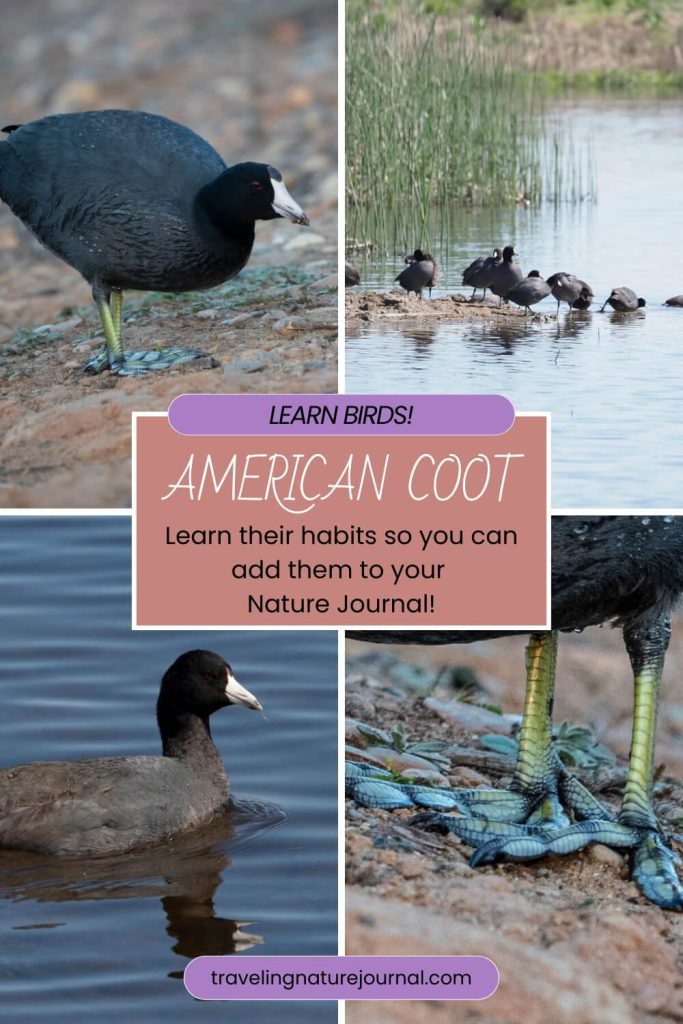
However, the American Coot feet are a bright yellow-green on the bottom. Unlike ducks with webbed feet, the American Coot has lobed feet. These vibrant feet are a great contrast to the bird’s overall blend-in vibe.
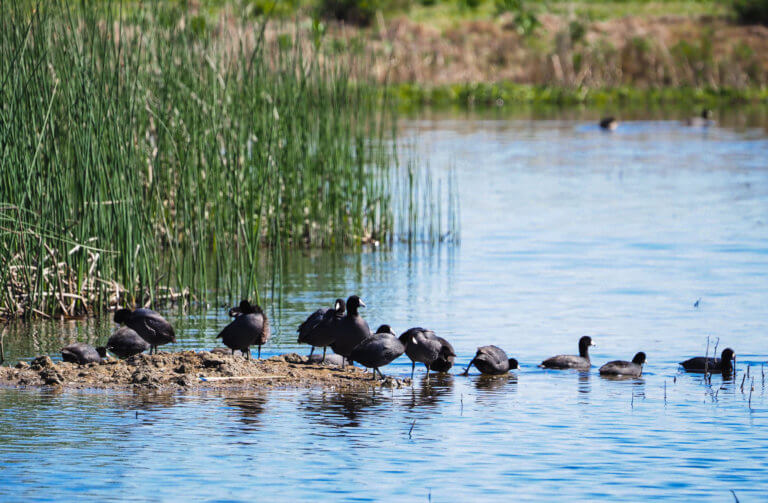
If you want to observe their behavior, your best bet is to find your local pond or wetland. There, you can bring your nature journaling supplies and settle in to watch them swim and walk near the water’s edge.
This post contains affiliate links. If you purchase a product or book through these links, I can make a small commission at no cost to you. It helps me to keep writing helpful posts!
List of Contents
American Coot & Nature Journaling
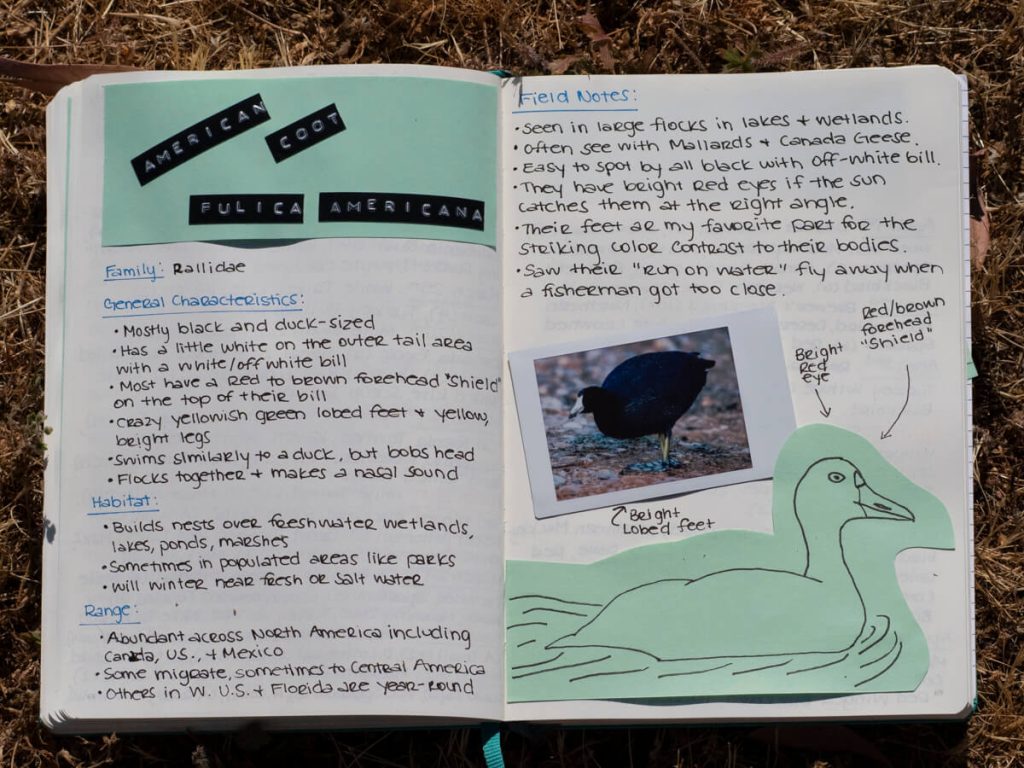
One of the best ways to learn about birds is to observe their behavior! I find it very peaceful to walk slowly around ponds and wetlands with my camera and journal. 📝
When I find a good spot, I’ll settle in and take photos. I like to use a 100-400 lens when photographing birds because I can stay far enough away not to affect their natural behavior.
Many people who are more artistically inclined might find sketching or watercolors better than photography. In that case, you only need a good monocular or binoculars to get a closer view.
While outside, take in your surroundings and the birds’ behavior.
Note in your nature journal things like:
- 🏡 How close are you to human infrastructure?
- ⏰ What time of day are you watching the American Coot?
- 🦆 Are there other birds around it? What are they? How close are they?
- 🍂 Have you seen the American Coot here before, or are they here seasonally?
- 🌱 How many American Coots are together?
Remember: your nature journal is entirely yours, and you can include whatever notes you find interesting.
I added mine as a possible example to give you some inspiration.
You can also make monthly species lists. This is a fantastically simple way to do a nature journal that has huge benefits. In keeping a monthly species list, you will see more patterns in your local bird migrations. It will also give you a daily reason to keep your eyes open for birds!
You can see species list examples with the American Coot in my March Species List.
If you’re looking at them while thru-hiking, check all the ponds!
Build Your Own Nature Journaling Kit!
📓 For everyday use, I like the Leuchtturm Plain.
🎒 For hiking, I like the small, plain Moleskine for packability.
👀 Grab a monocular or some binoculars to see more.
📚 My favorite birding book is by National Geographic.
📷 Grab a telephoto lens for your camera.
🎞️ Add a photo from your phone or camera with a Polaroid printer.

American Coot Feet: Unqiue Yellow, Green, and Lobed

The American Coot feet are definitely the most noticeable part of the bird! Depending on the bird, their foot color ranges between yellow, green, and a mix of both.
Make sure you look when they are looking for food at the edge of a body of water!
Is the American Coot a Pest?
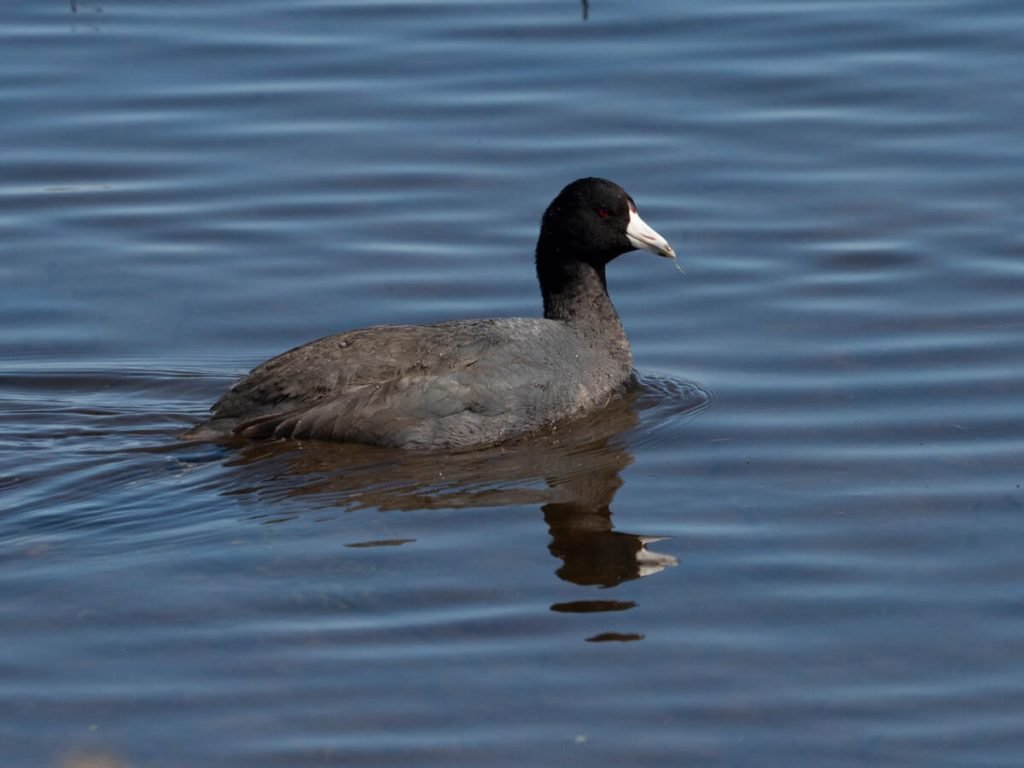

To the average bird enthusiast, no, the American Coot is not a pest.
However, golfers and people who upkeep golf courses tend to think of American Coots as pests.
Because American Coots usually flock together, they find new ponds as a group. If that new pond happens to be a water feature at a golf course, they don’t fit into the manicured, unnatural landscape of the course.
Moreover, when the American Coots exit the golf course pond, they leave scat all over. Supposedly, their scat has worsened players’ scores.
This begs the question: Are you really a good golfer if you can’t adapt to environmental changes? 🤔
Other complaints often center around American Coots making “too much noise.”
The American Coot has vibrant lobed feet, and when it takes flight, it tends to “run on water.” Thus, the lobed feet smack loudly on the water. When a flock of American Coots takes flight from the water, they create a lot of noise.
Family:
Rallidae
American Coot General Characteristics:
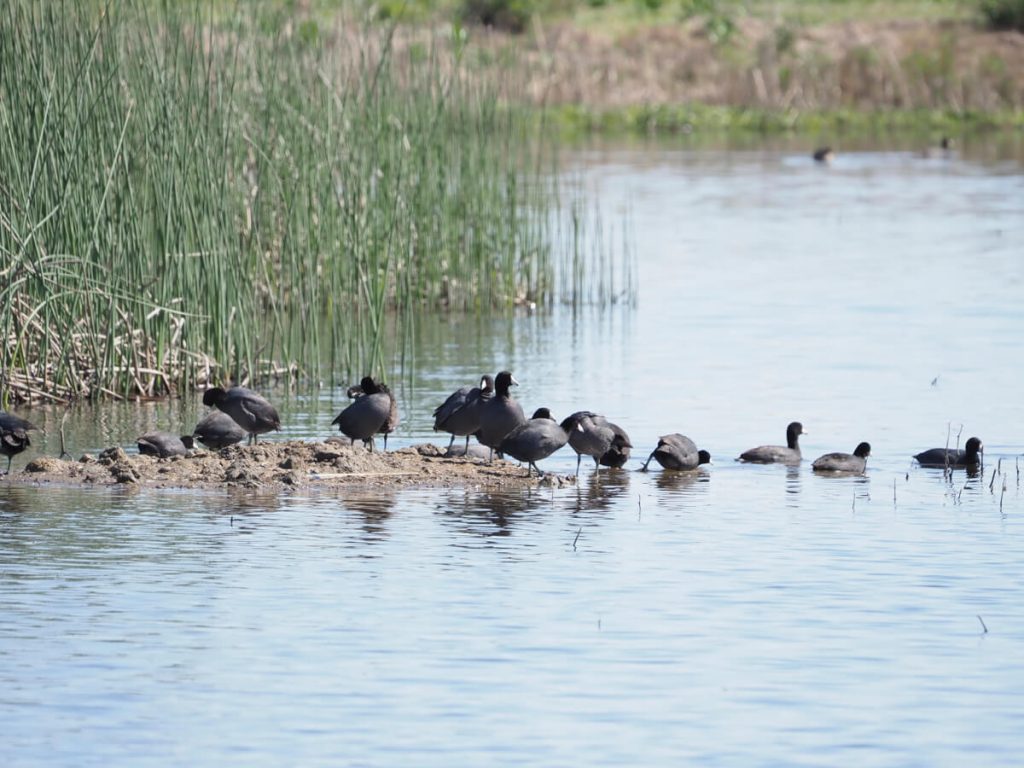
- Mostly black and duck-sized
- Has a little white on the outer tail area with a white/off-white bill
- Most have a red to brown forehead shield on the top of their bill
- Crazy yellowish green lobed feet and legs
- Swims similarly to a duck and
- Flocks together and makes a nasal sound
Habitat:
- Builds nests over freshwater wetlands, lakes, ponds, marshes
- Sometimes, in populated areas like parks near water
- Will winter near fresh or salt water
Range:
- Abundant across North America.
- Some migrate, sometimes to Central America
- Others in the Western United States and Florida are year-round residents.
📌 Pin the American Coot for Later Reference!