The lesser-known Camino Finisterre and Camino Muxía meander from Santiago to the Atlantic Ocean in 56 miles or 90 kilometers. This enchanting walk takes you through Galicia, Spain, and is NOT as crowded as the last 100km into Santiago!
You can walk either the Camino Finisterre or Camino Muxía as a standalone trail. Or, you can extend whichever Camino you walked to Santiago out to the ocean!
I’ve hiked 4 different Caminos de Santiago. Each time, I continued to Finisterre, Muxia, or both. Personally, I’m not religious and did not want to end my hike at a cathedral. Instead, I found it far more peaceful to continue and finish at the ocean.
So whether you only have a week’s vacation or you want to finish at the ocean, I’ll tell you everything I know below.
This post contains affiliate links. If you purchase a product or book through these links, I can make a small commission at no cost to you. It helps me to keep writing helpful guides.
List of Contents
Why Do People Walk to Finisterre and/or Muxía?
Like any Camino, there are 100 or more personal reasons why someone wants to hike to Finisterre or Muxía.
The main reasons you’ll hear include:
- 🌊 Desire to finish at the ocean where you can’t walk anymore.
- 🏡 A person might not be religious, and thus, a cathedral doesn’t evoke the same emotions.
- 👯 After the super busy last 100km to Santiago, the Camino Finisterre-Muxía is calmer.
- ✈️ If you only have a week of vacation time, it’s a great hike!
- 🪨 Finisterre is the Pagan end of the Camino and translates to “the end of the earth.”
With the Caminos de Santiago getting increasingly crowded, walking to Finisterre or Muxía can be worthwhile.
Santiago de Compostela is a hectic, touristy city. After walking to Santiago 4 times, I find it chaotic. On the other hand, Finisterre is a small town with some touristy elements. Muxía is a small fishing village that receives a lot less attention.
Camino Finisterre and Camino Muxía Map
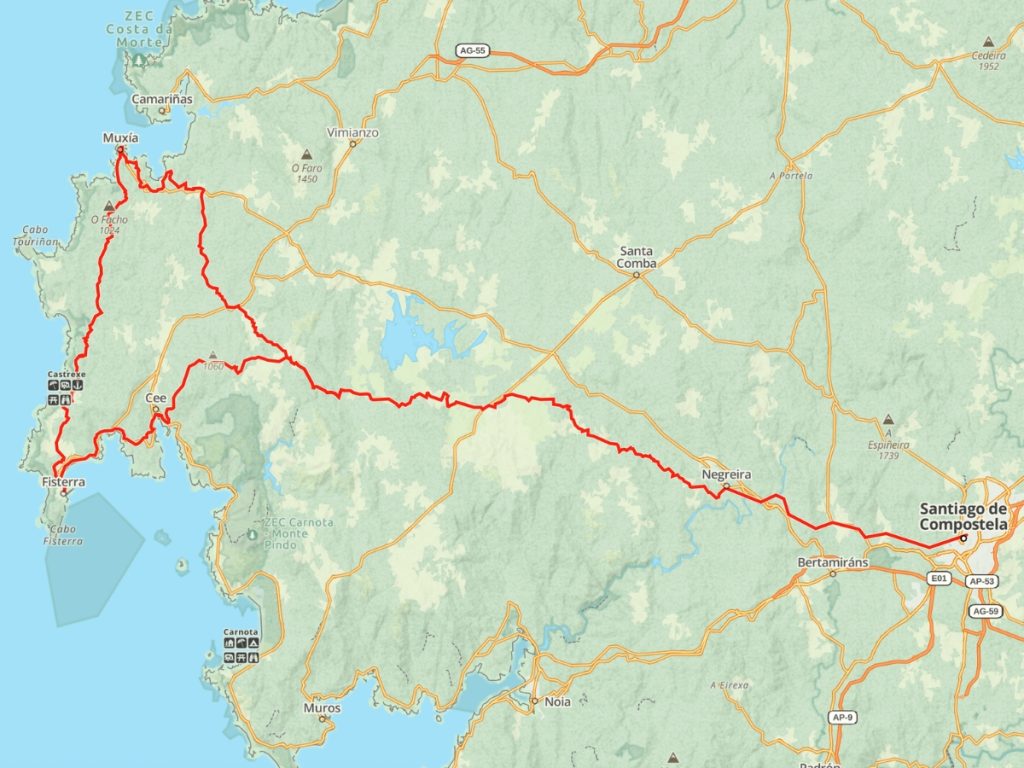
As you can see from the map, there is a significant overlap between the Camino Finisterre and Camino Muxía.
Some distances:
- Camino Finisterre from Santiago: 55.9 miles (90 kilometers)
- Camino Muxía from Santiago: 54.3 miles (87.5 kilometers)
- Finisterre to Muxía: 17.5 miles (28.1 kilometers)
Why You Should Extend Your Camino de Santiago to Finisterre and/or Muxía
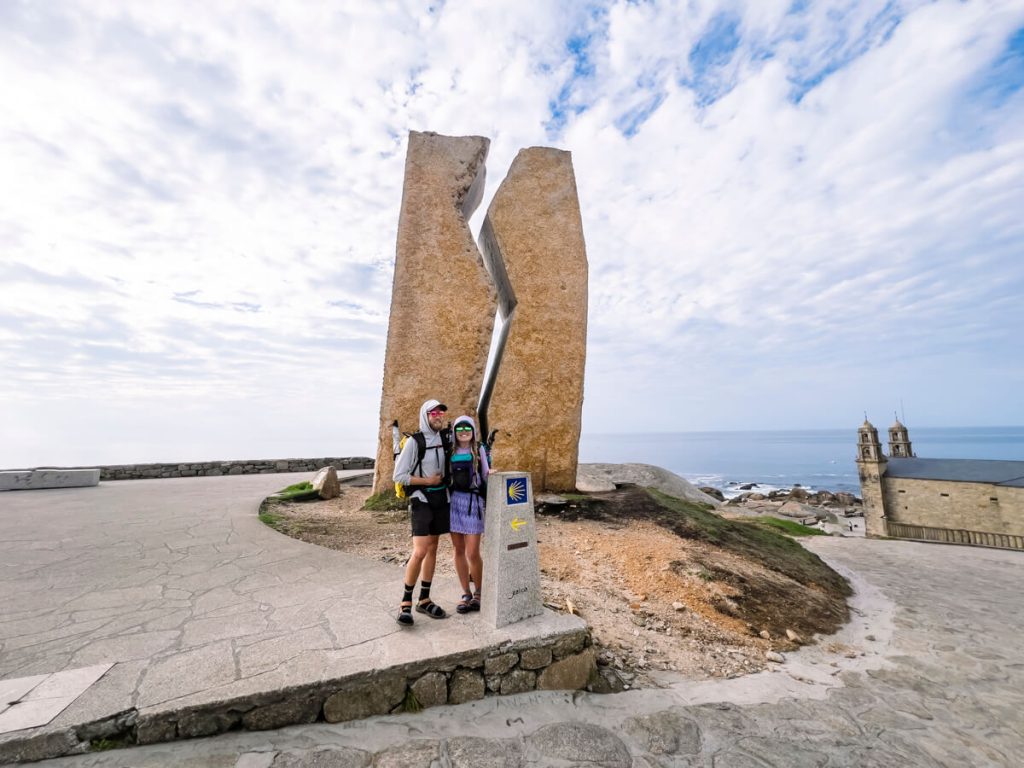
After 4 Caminos de Santiago, I HIGHLY recommend extending your journey to Finisterre and/or Muxía.
Santiago is a small city AND the end of most people’s Camino journeys.
People are everywhere in Santiago. They are full of emotion from completing their goal. Many have never walked that far in their life, and it’s an incredible feeling. However, because of that, Santiago doesn’t offer much relaxation or reflection space.
If you have the time and energy to walk more, I recommend continuing your walk to have that space for reflection.
Both the Camino Finisterre and the Camino Muxía are significantly less crowded walks. They offer forest stretches, small towns, and, eventually, ocean views.
In my experience, there’s something special about walking to the ocean. You simply can’t walk west anymore. In my opinion, the ocean makes more sense as the end of a hike.
Why Finisterre and Muxía are Famous
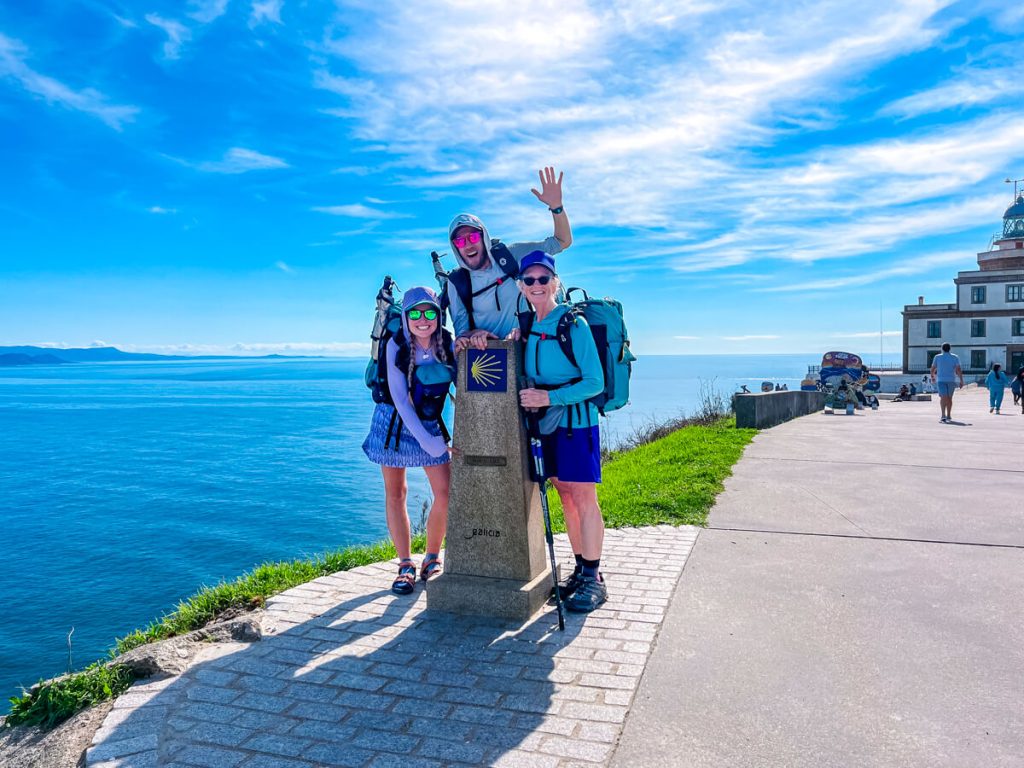
Finisterre is the “end of the earth” or “end of the world.” You’ll also see it called Fisterra, which is its Galician name.
Before the pilgrimage to Santiago began (circa 900-1000 C.E.), people walked to Finisterre because it was the westernmost point in continental Europe. Thus, it was the point in Europe where you could walk no further west.
Traditionally, those who continued their walk to Finisterre burned their socks at the lighthouse. It symbolized the ending of the journey. Now, you cannot start a fire there. This was also before the epic lifetime warranty of Darn Tough socks…aka the only socks I’ll thru-hike in!
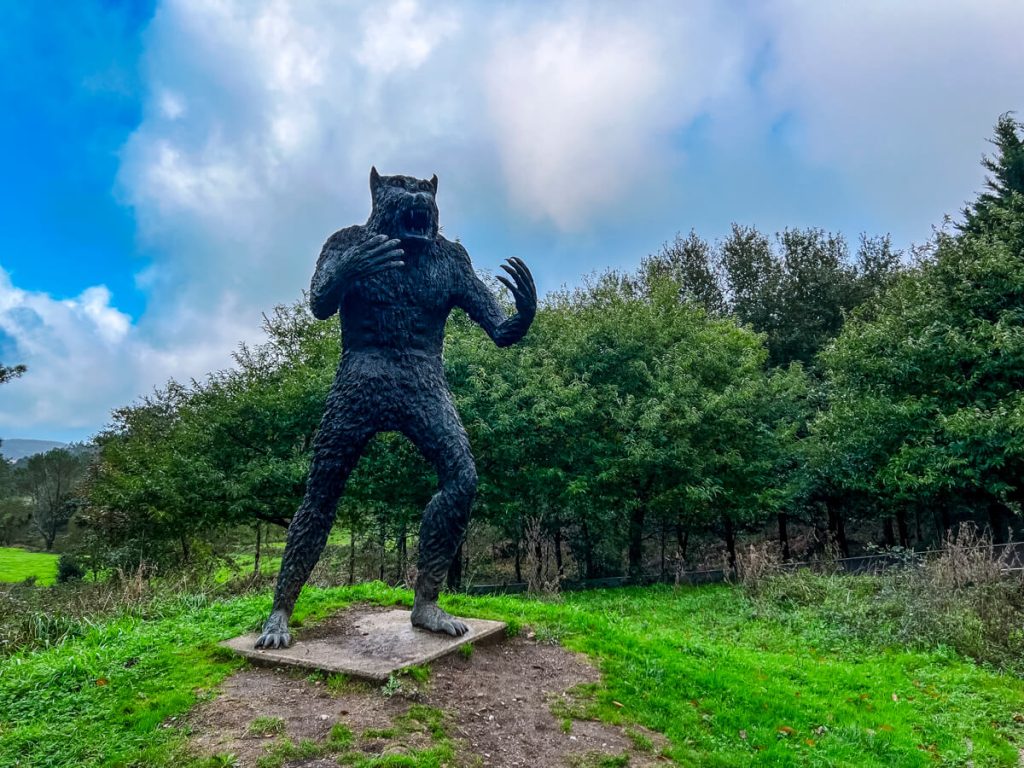
My favorite fun fact: If you got werewolf vibes from the wooded sections…you’ll be excited to hear that just after the Great Divide, there is a werewolf statue! The origins of the modern werewolf started in this area of Galicia with the legend of Vákner…AKA the first werewolf.
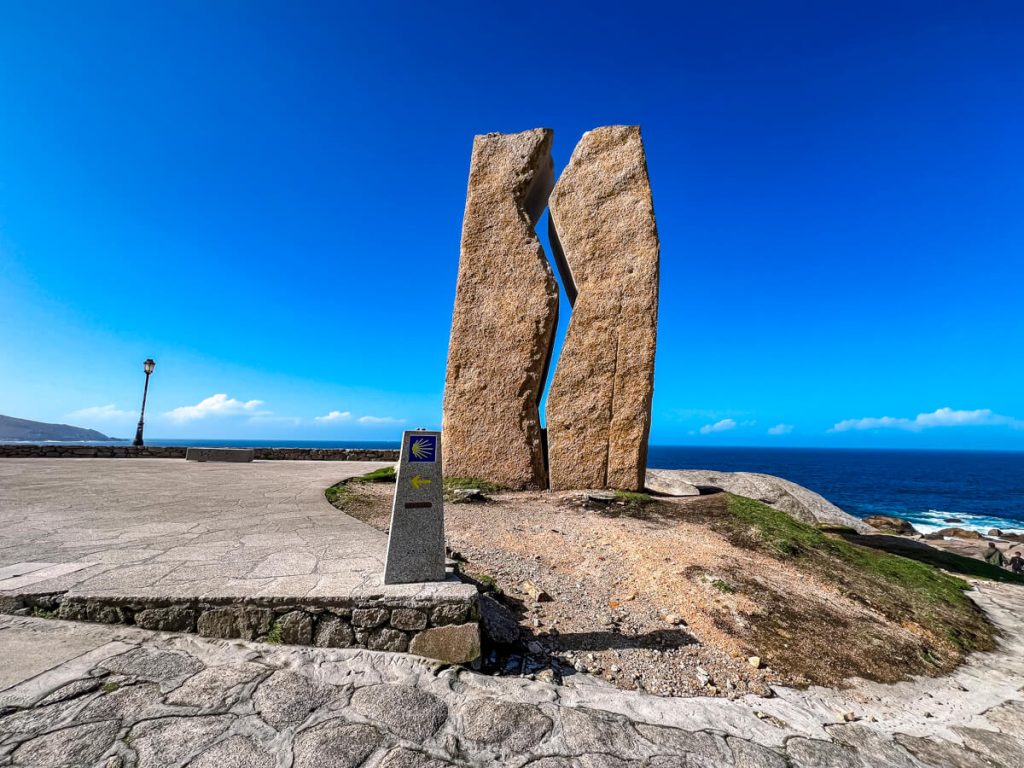
Muxía is known for two monuments and a church (Santuario da Virxe da Barca).
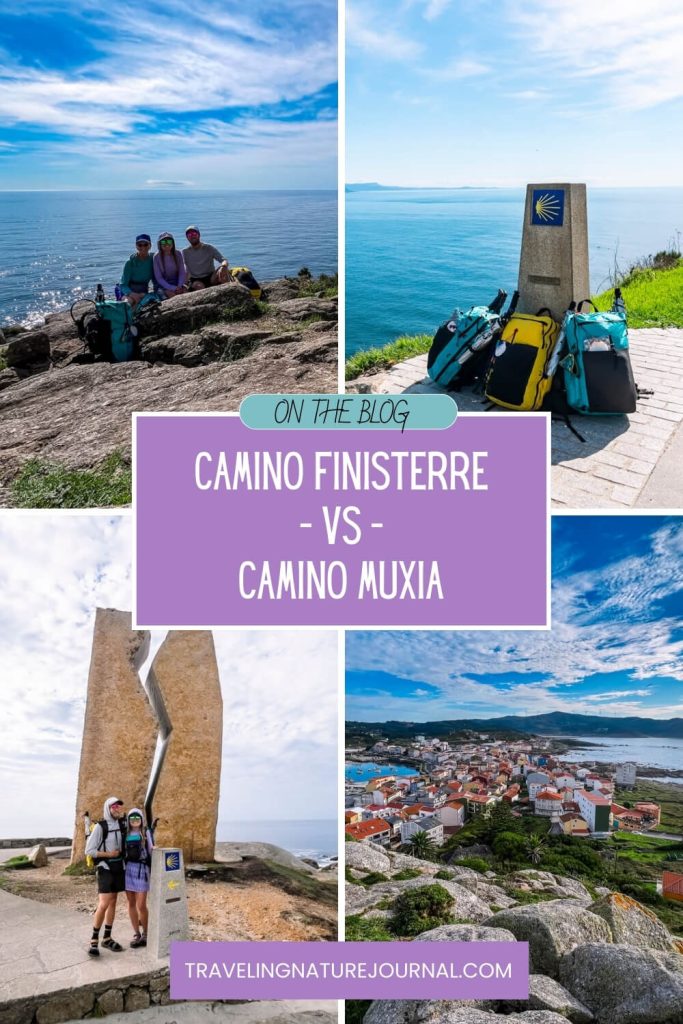
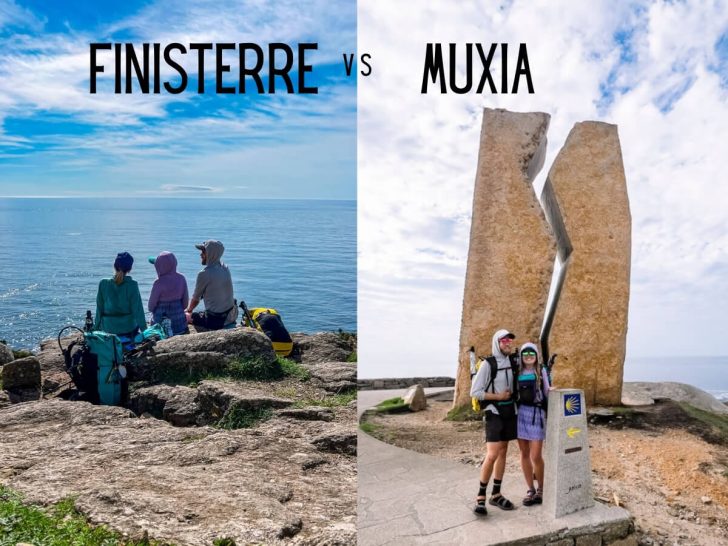
The newer, prominent monument is a giant split rock. It is a reminder of a nearby ecological disaster. A massive oil spill wreaked havoc on the area in 2002.
The natural monument is a large boulder that shifts in the wind. You can find a spot to watch both it and the waves.
Which is Better: Finisterre or Muxía?
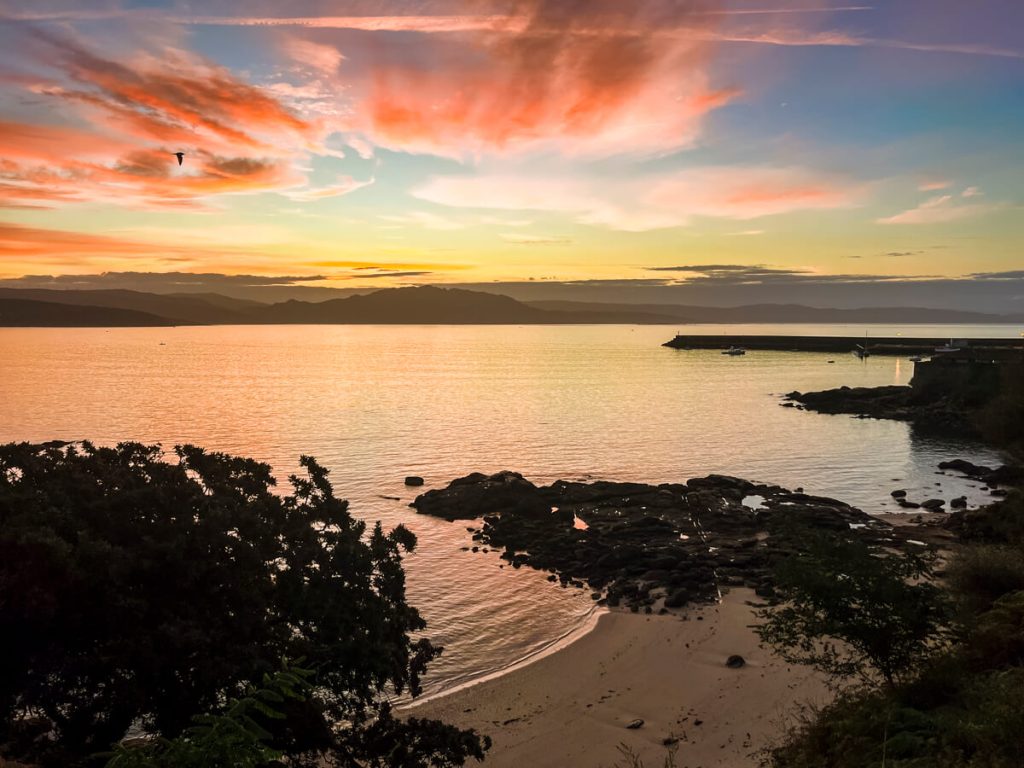
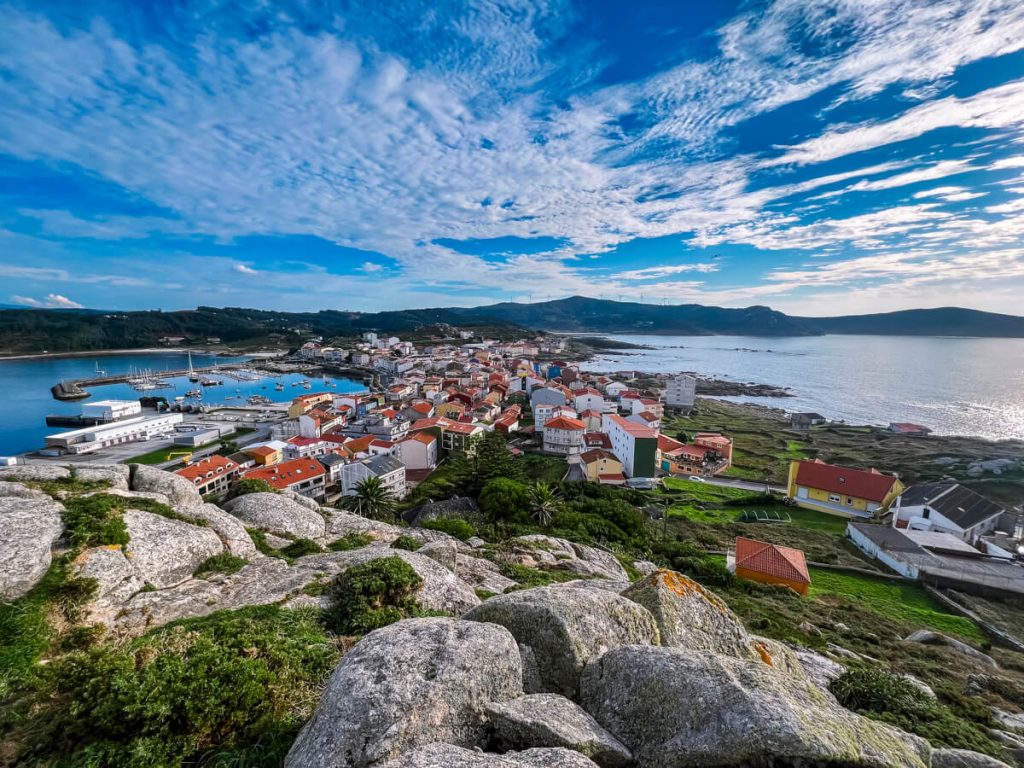
I’ve walked four different versions of the Camino Finisterre-Muxía:
- Just the Camino Finisterre (from Santiago to Finisterre and the bus back).
- Just the Camino Muxía (from Santiago to Muxía and the bus back).
- From Santiago to Finisterre, then Finisterre to Muxía, and then Muxía to Santiago (no bus).
- From Santiago to Finisterre, then Finisterre to Muxía, and the bus from Muxía to Santiago.
Thus, I get asked this question frequently: which is better, Finisterre or Muxía? The answer is that it depends on what you’re looking for.
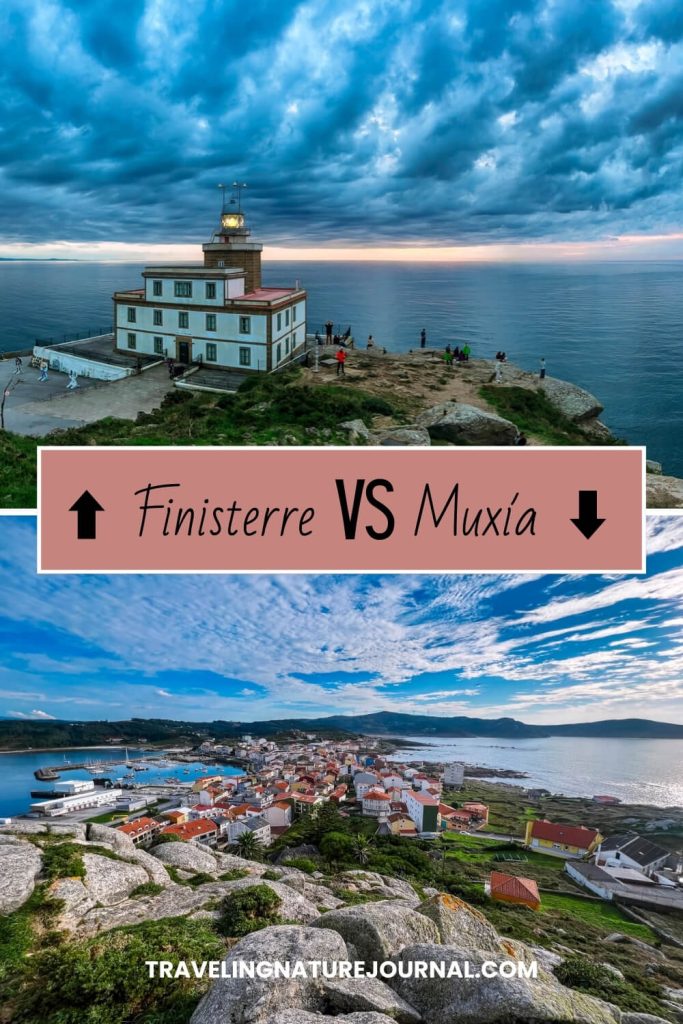
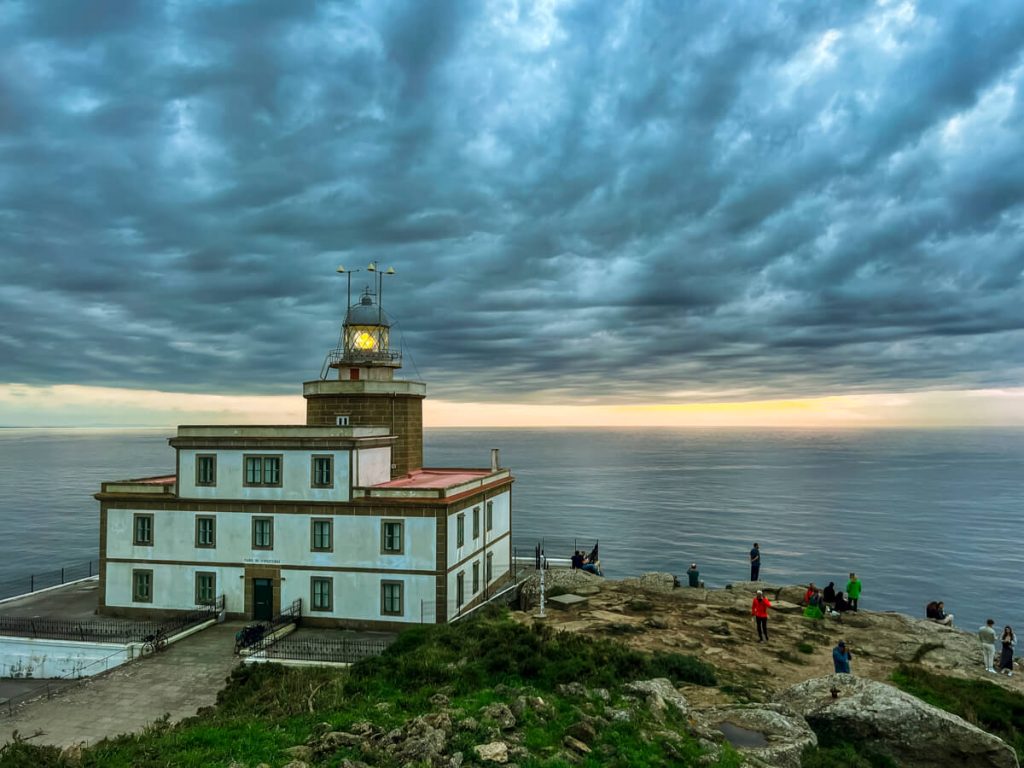
Finisterre is the traditional, pagan “end of the earth.” The town of Finisterre has a very hippie vibe that’s getting more touristy as the years go on. There is a plethora of restaurants. You find a wide range of accommodations from albergues to hostels to private rooms, to regular hotels, to fancy Airbnbs. The kilometer zero is near a historic lighthouse on picturesque rocky cliffs overlooking the ocean.
Muxía is a small fishing village with a more local vibe and is not very touristy. It has a few small grocery stores and only a few restaurants. It’s a chill town that has a few local trails and beaches. The kilometer zero is by a relatively new monument on the coast with a view of waves crashing on large boulders.
If you want to hike both, consider which vibe you want to end with. Personally, I love Finisterre, but I prefer to end in Muxía. You could easily switch this if you’d like.
How Long Does it take to walk the Camino Finisterre or Camino Muxía?
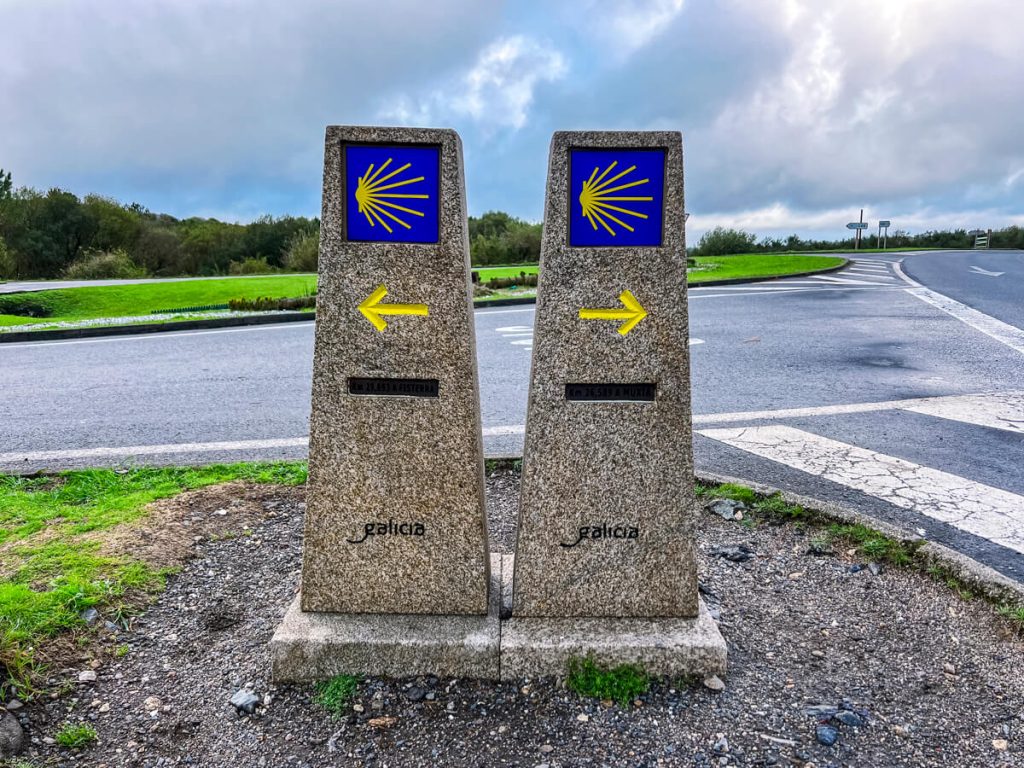
On average, it takes 3-5 days to walk to Finisterre or Muxía, based on your fitness.
If you take the Camino Finisterre from Santiago, you’ll walk 55.9 miles (90 kilometers) over 3 stages. The marked stages have you stay in the two largest towns on the way to Finisterre.
However…you 👏 don’t 👏 have 👏 to 👏 follow 👏 the 👏 marked 👏 stages.
You may want to take extra time because it’s cheaper to stay in albergues. Or, you may not be up for longer mileage days. Either is doable.
If you opt for the Camino Muxía instead, you’ll walk 54.3 miles (87.5 kilometers) from Santiago to Muxía. According to the 3 marked stages, you would stay in the same towns as you would on the Camino Finisterre but take a right at the Great Divide instead of a left.
Most people opt to go to one or the other and then take the bus back to Santiago the next day. However, you can walk between Finisterre and Muxía.
Can You Walk Between Finisterre and Muxía?
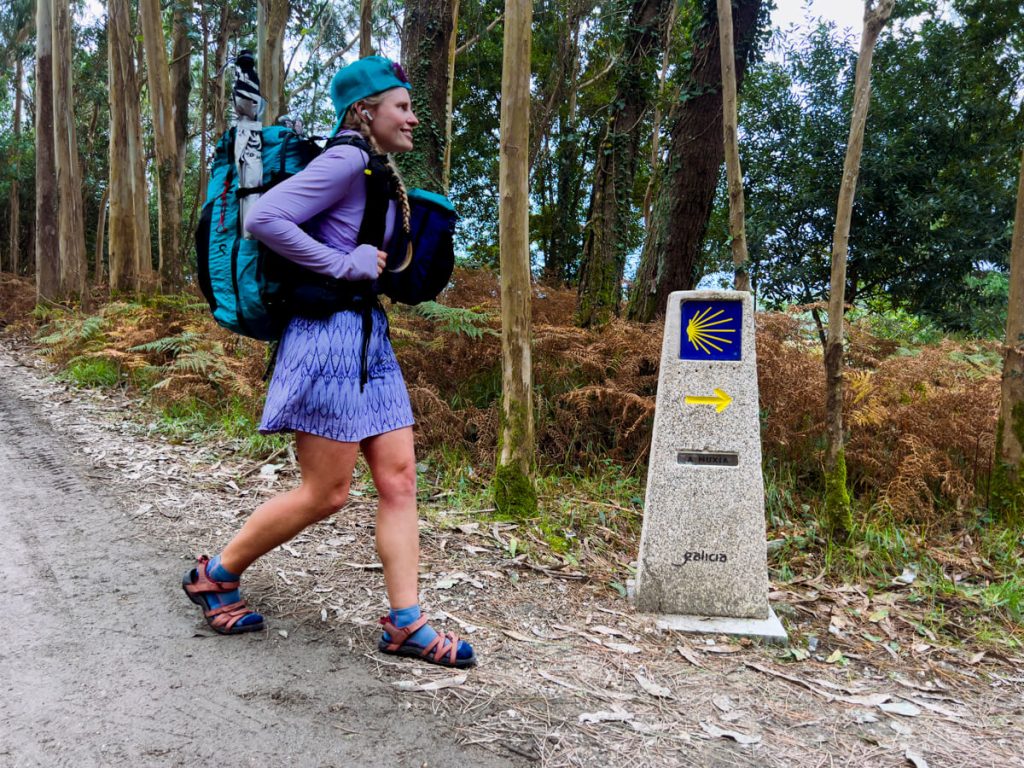
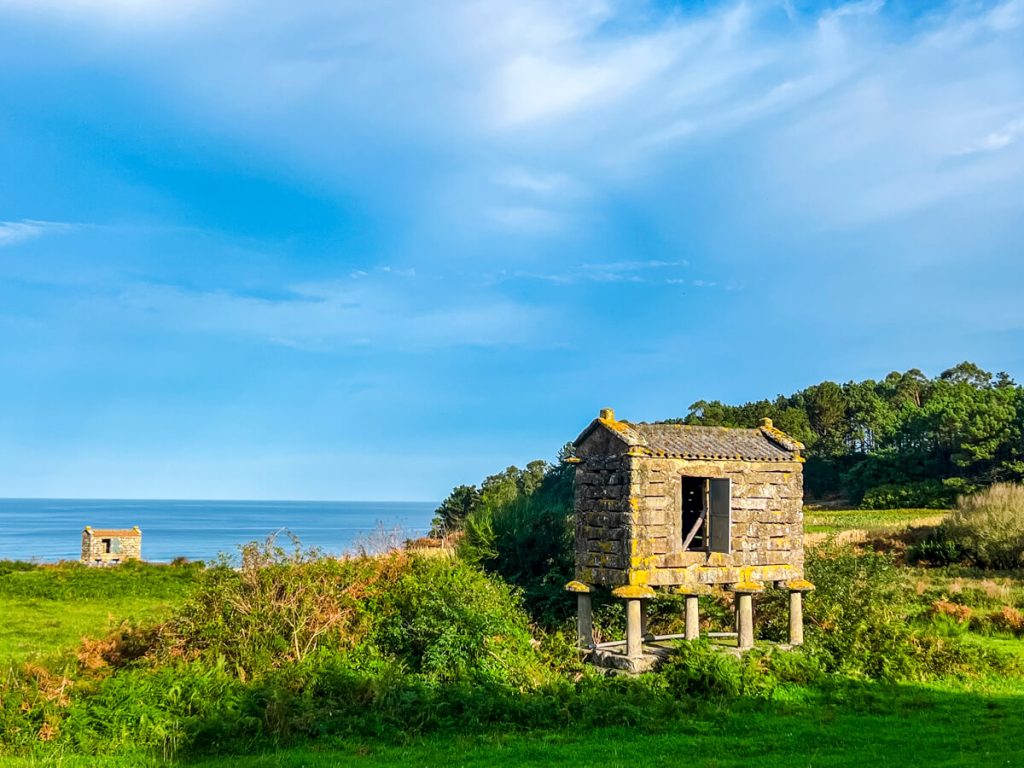
Yes, it’s possible to walk 17.5 miles (28.1 kilometers) between Finisterre and Muxía. You can hike it in either direction with way markers.
There are two main strategies to hike it:
- Hike for one day and do the whole 17.5 miles (28.1 km).
- Hike for two days and stop in the town of Lires, roughly in the middle.
I’ve walked between Finisterre and Muxía twice on my 3rd and 4th caminos. Both times, I went to Finisterre first and Muxía second. In my opinion, while the vibe of Finisterre is more chill than Santiago, the vibe of Muxía is even more chill than Finisterre.
On my 3rd Camino, I did the Finisterre-Muxía connection in two days with my Mom. We stayed in Lires, and it made both days easy walking. We brought extra food from Finisterre with us because Lires is very small and usually only has one food restaurant open at a time. Thus, if you opt to stay in Lires, bring extra food from either Finisterre or Muxía.
In contrast, on my 4th Camino, Karma and I did this section in one day. As perpetual thru-hikers, we were not intimidated by the distance. We brought our snacks for the day from Finisterre. We also got an ok, but not great, lunch in Lires.
Would I recommend this addition? Yes! If you have the time and the energy…why not?
Accommodation Options on the Camino Finisterre-Muxía
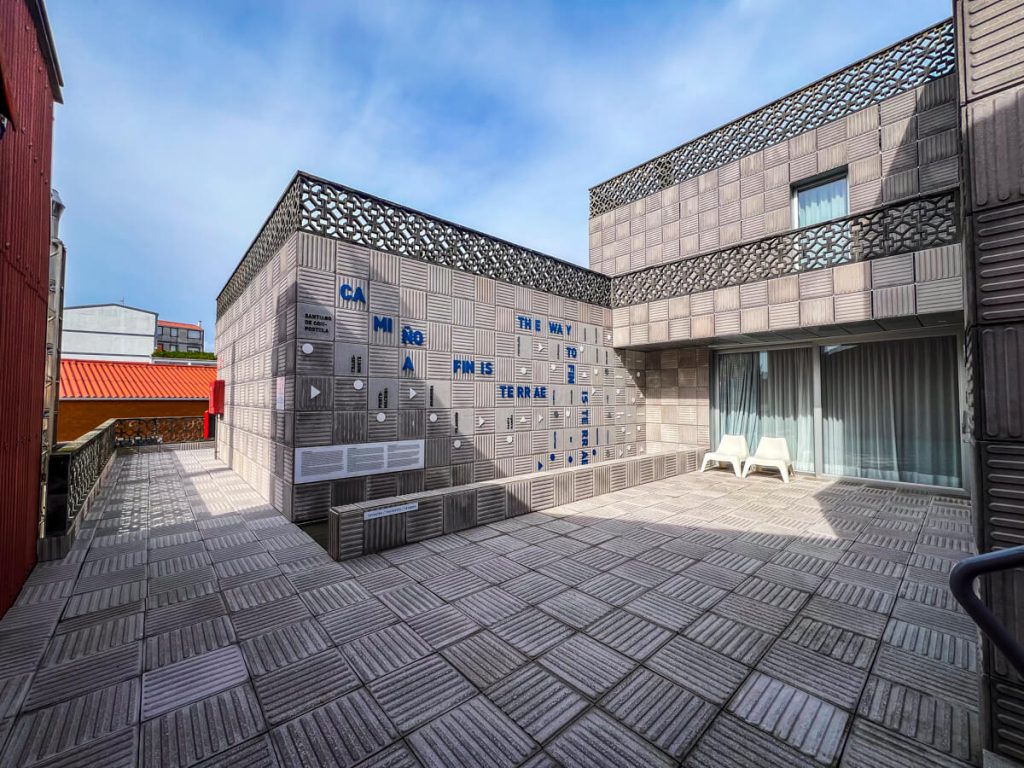
In the larger towns marked by the stages, there are several options for albergues, both municipal and private. You’ll also have a few private room options.
Outside the larger towns, you’ll have several standalone albergues with an attached restaurant or kitchen. If you plan to break up the stages differently, ensure you can eat at the attached restaurant. If you’re unsure, carry food from the larger town prior.
For example, I love breaking up the stages with the albergue/restaurant in Lago. Albergue Monte Aro is a small, family-run business with a comfortable set-up. I was pleasantly surprised that the woman running it said she could easily make a vegan option for the pilgrim menu. It lacked protein but tasted fantastic. But…it has nothing else around it, so you either eat at the restaurant or eat the snacks you’ve brought.
Another of my favorite albergues is Bela Muxía (pictured above). I love sharing one of the private rooms upstairs with friends, watching the sunset from the roof, and enjoying the large kitchen space. The couple running it are some of the kindest people I’ve ever met.
Food Options on the Camino Finisterre-Muxía
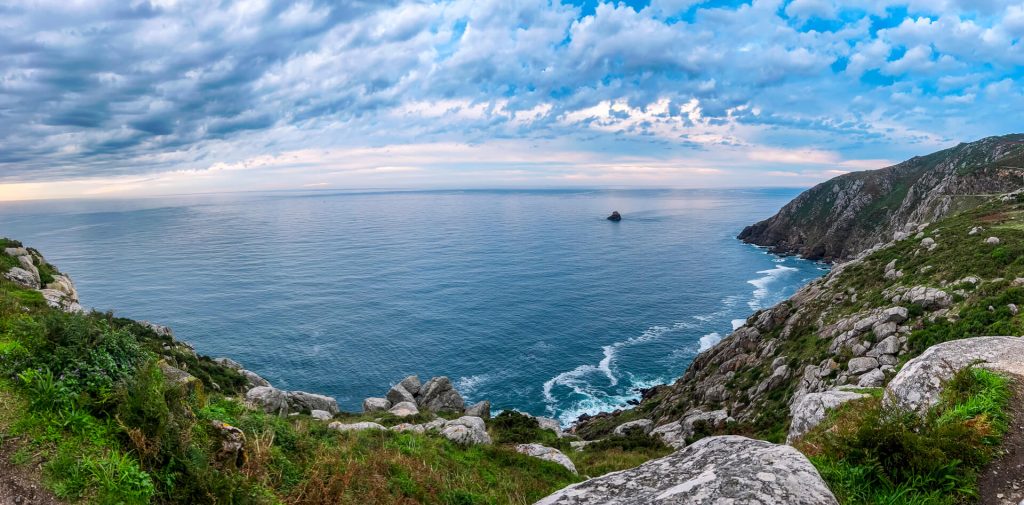
There are fewer towns, restaurants, and grocery stores on the Camino Finisterre and Camino Muxía than you’ve grown used to on the way into Santiago.
The towns and food options are spaced a little farther apart. The longest gap is 15 km, with no services after the “town” of the Hospital. I put town in parentheses because it’s really only a restaurant, so make sure you get there when it’s open.
You’ll have decent grocery stores at the ends of each stage: Negreira, Olveiroa, Cee (Camino Finisterre), Finisterre, and Muxía.
If you’re a person who likes snacks…make sure you use those grocery stores!
I had no trouble as a vegan on the Camino Finisterre-Muxía strategically using grocery stores and the Happy Cow app.
Camino Finisterre Certificate & Camino Muxía Certificate
Most people will hike one of the Caminos to Santiago and get their Compostela. Then, they would extend their Camino to Finisterre or Muxía and receive a second certificate.
Essentially, the Camino Finisterre and Camino Muxía have their own separate certificates.
While you cannot get the Compostela from the Camino Finisterre-Muxía (neither is 100km), you can get either the Fisterrana or the Muxíana. Although *technically* you could walk from Finisterre to Muxía to Santiago, and it would be 115.6 km. If anyone does this and gets a Compostela…tell me about it in the comments!
You can get the Fisterrana at the Tourism Office in Finisterre. Check their hours before you get to town so you don’t miss it!
In Muxía, you need to go to the tourism office as well. It does not have great hours. Definitely, look them up ahead of time.
Don’t Have Time to Walk? Take the Bus from Santiago to Finisterre or Muxía!
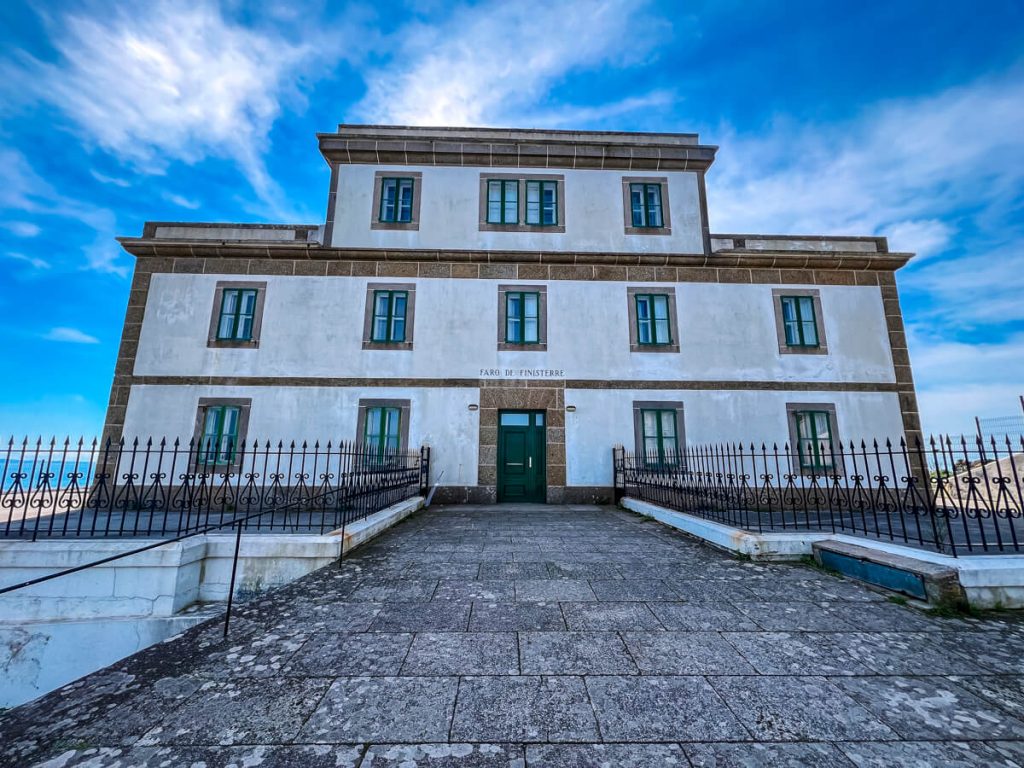
If you got to Santiago early but don’t have the time or energy to walk to Finisterre or Muxía, consider a bus tour!
You can DIY your way out to either Finisterre or Muxía using the local buses. If you’re trying to save money, this is the cheaper option.
- Reserve tickets both there and back beforehand so you can make the bus. The only bus is Monbus. It also uses the Galician name for Finisterre, so make sure to type in “Fisterra.”
- You’ll want the morning bus to Finisterre or Muxía and one of the afternoon buses back.
- While there, you’re on your own for activities and food.
- Remember: the bus to Finisterre drops you in the town—the lighthouse is a 3.2 km walk further. You could also grab a taxi for approximately 8-10 Euro each way.
- The walk to the Muxía kilometer zero is only about 1 km.
If you want to take a tour, they do all the logistics for you. The guides are knowledgeable and will talk to you about the history of these coastal towns. You can also see more of the Galician coastline this way!
I’ve gone on similar Get Your Guide trips in Portugal and Spain and loved them. Personally, after making all the decisions constantly on the Camino, it’s fantastic to decide on a tour and not get any more decision fatigue.
How to Leave Finisterre/Muxía (Bus from Finisterre/Muxía to Santiago)
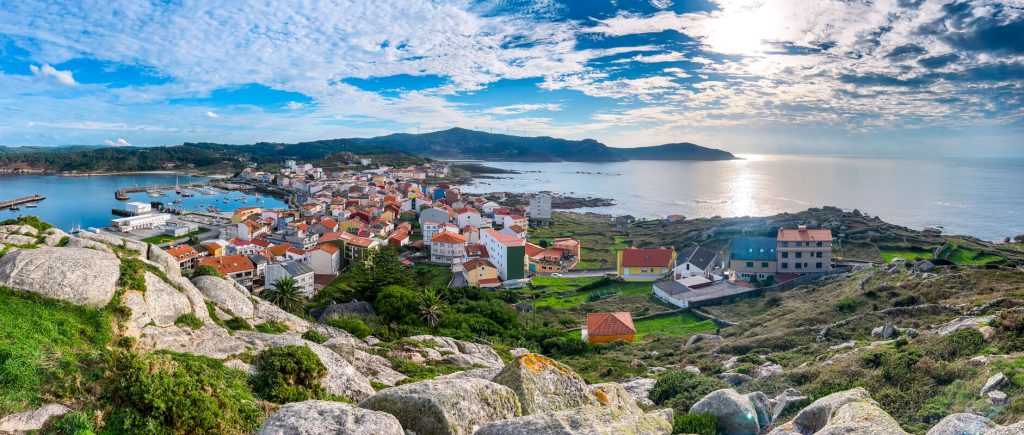
If you walked the Camino Finisterre-Muxía, you’re best option is to take the bus back to Santiago. There is one local bus line that runs 2-4 times per day every day (depending on the season).
🚨 Pro Tip: 🚨 Book this ONLINE one day or more in advance! If you wait, you risk the bus selling out from both other pilgrims AND locals.
Alternatively, if you are desperate, you can pay for a taxi to get to Santiago (which is very expensive).
From Santiago, you can take a bus, train, or plane elsewhere. The easiest move is the bus or train to Madrid and flying from there.
Final Thoughts After Walking the Camino Finisterre-Muxía 4 Times
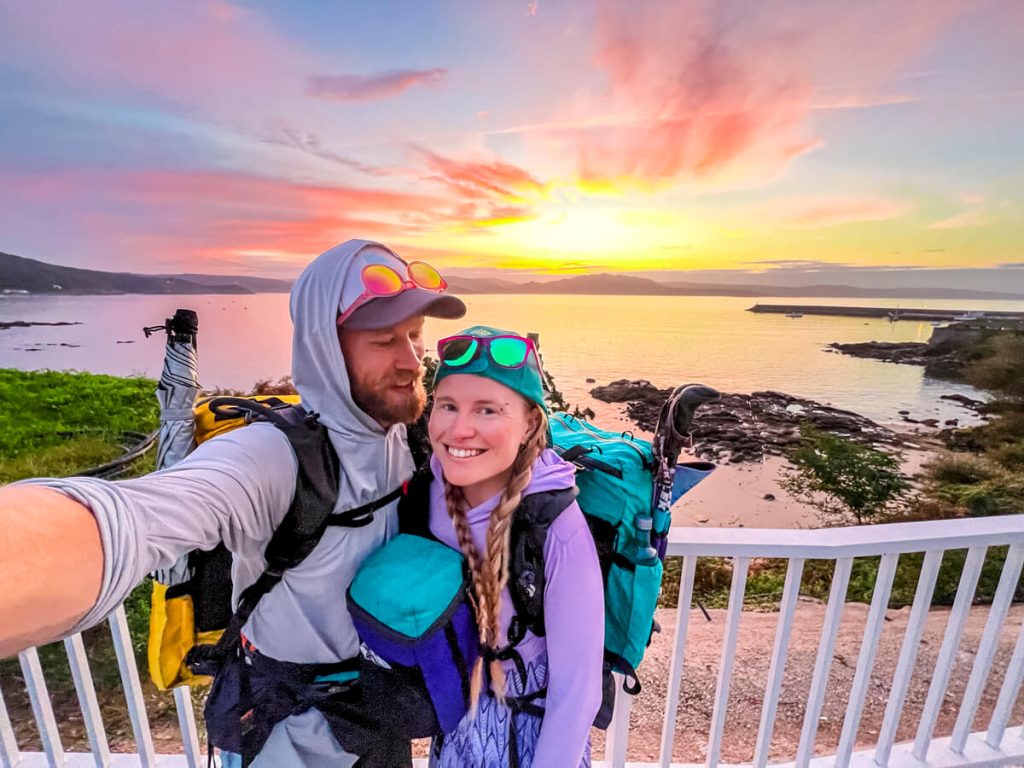
In my opinion, I always recommend adding the Camino Finisterre-Muxía to the end of your Camino. It’s got forests, hills, views, and the ocean. Most importantly, there are significantly fewer people than the last 100 kilometers into Santiago.
You’re already in excellent walking shape from whichever Camino you completed…so why not see the ocean?!
I also LOVE that you can meet people who have completed other caminos. You’ll hear stories from new friends and get ideas for your next adventures. Don’t underestimate talking to new people on the Camino Finisterre or Camino Muxía.
It’s worth it to add the extra time and distance to see these really unique towns. If you find you only have time for a day bus tour trip…it’s also worth it!
📌 Pin it for Later!