Ultimate Guide to Hiking the Portuguese Camino de Santiago
Walking the Portuguese Camino de Santiago is a unique experience, even amongst other Caminos. After walking from Lisbon to Santiago and out to Finisterre in the fall, here’s everything I learned about the route.
I’ll walk you through it all, from your planning process to packing your backpack to finding and staying in albergues. You’ll be walking and living your dream in no time with a little preparation.
As the Portuguese Camino gains popularity, there are more options than ever to consider. Not only can you decide where to stay each night, but you also have route options: the coastal, central, and spiritual routes. I’ll help you sort through what the route options are and how long they’ll take.
This is all the information that I wished I had before embarking on the hike. Let’s dive in from the beginning, and we’ll have your backpack packed by the end of this post!
This post contains affiliate links. If you purchase a product or book through these links, I can make a small commission at no cost to you. It helps me to keep writing helpful guides.
List of Contents
Walking The Portuguese Way Quick Facts
Start: Lisbon or Porto
Finish: Santiago de Compostela
Distance:
- Lisbon to Porto: 227.9 miles (366.8 kilometers)
- Porto Coastal Route: 168.6 miles (271.3 km)
- Porto Central Route: 149.4 miles (240.4 km)
- Santiago to Finisterre or Muxía: 55.9 miles (90 km)
Difficulty: Beginner/Intermediate
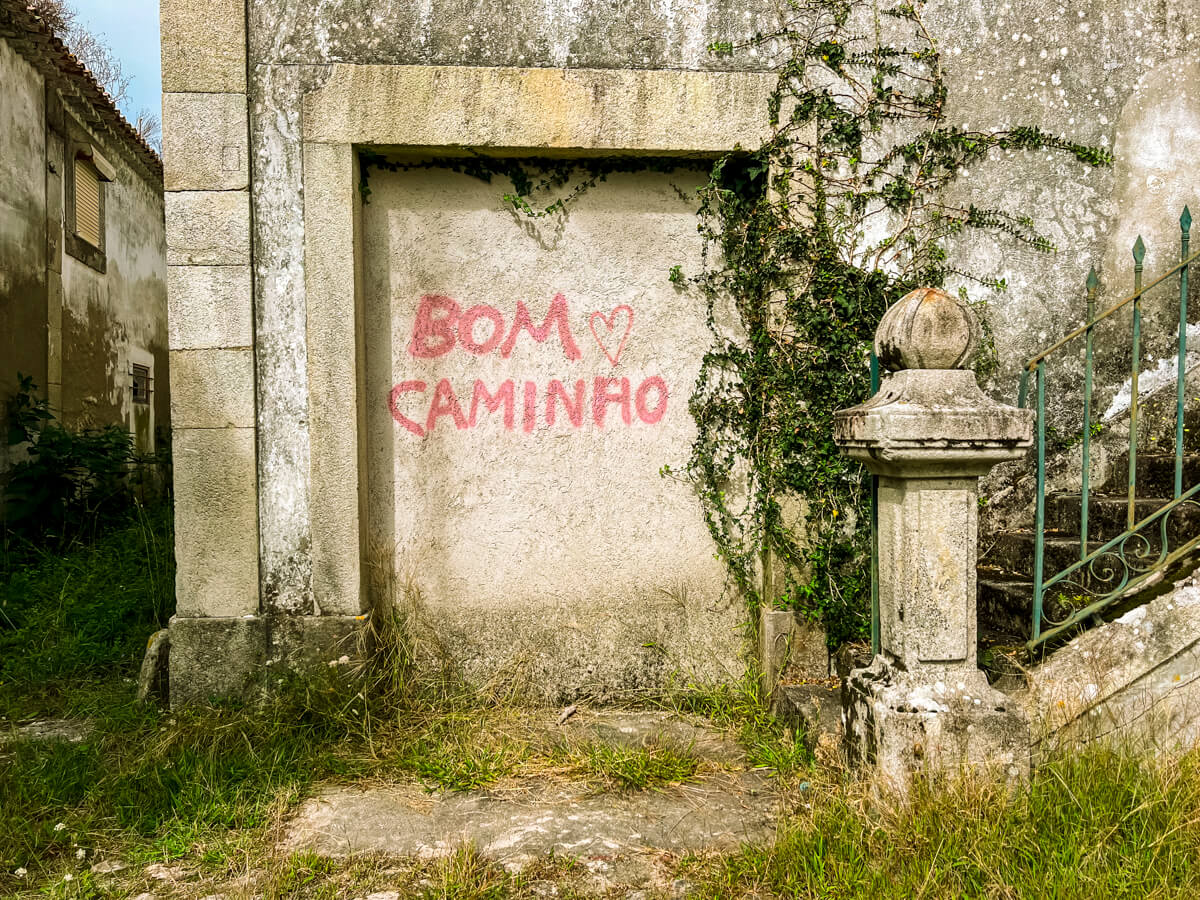
Greeting: Bom Caminho in Portugal instead of the Spanish Buen Camino.
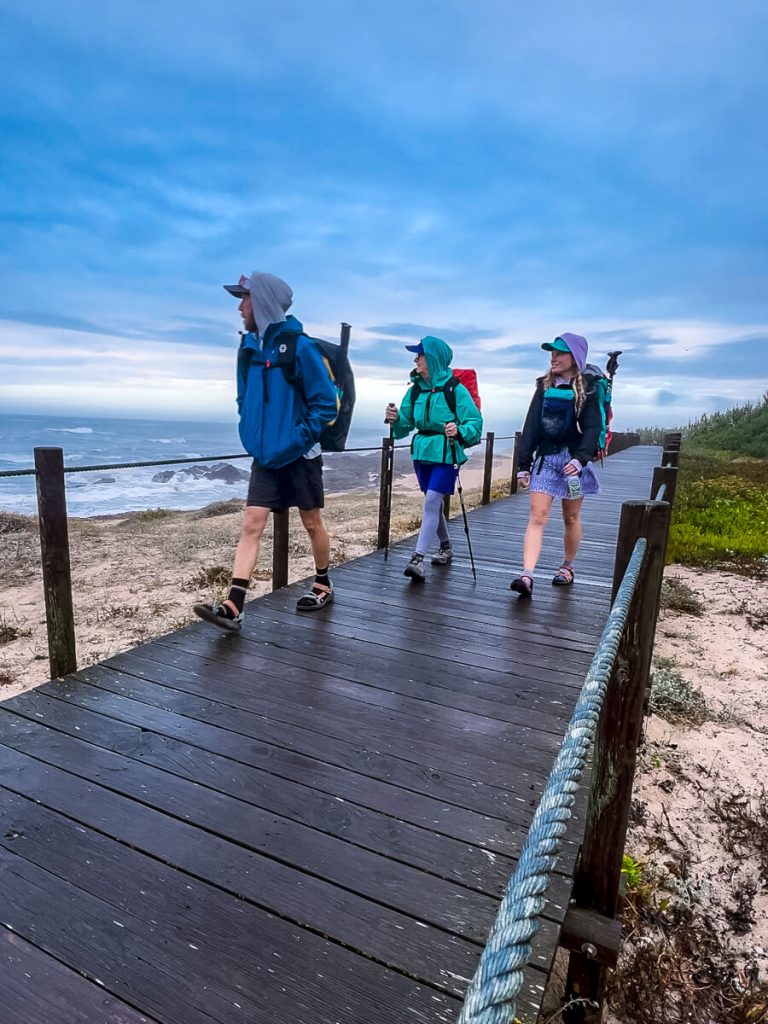
Portuguese Camino Packing Essentials
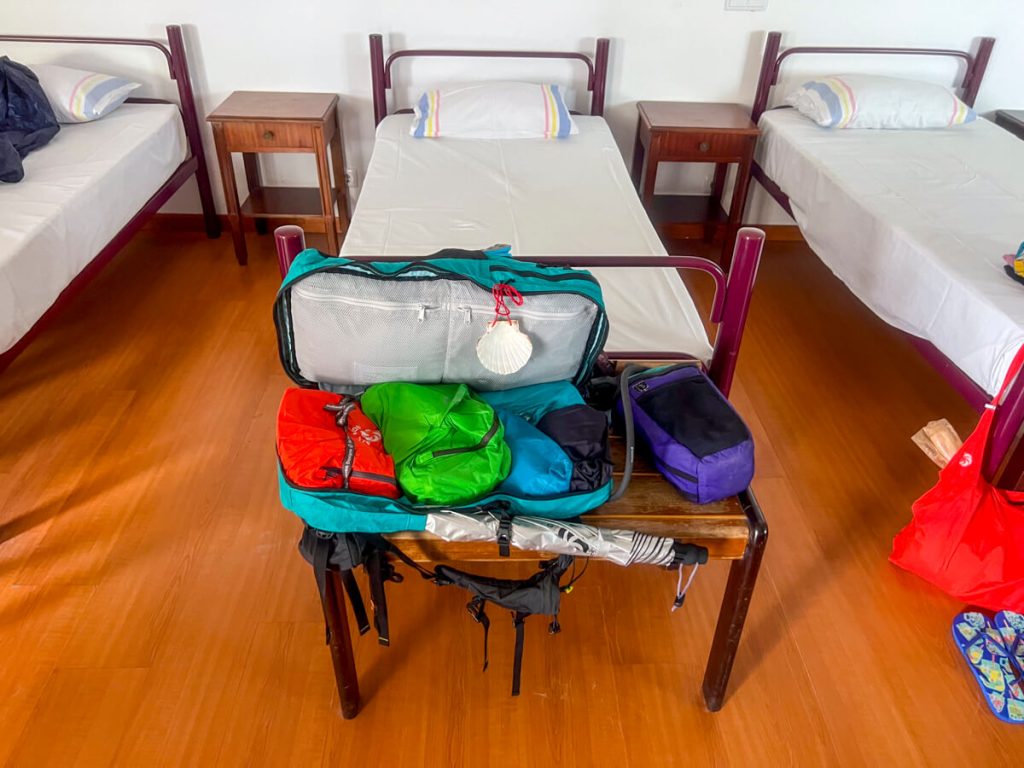
Packing a Camino backpack is a blend of preparing for a backpacking trip and an international sightseeing trip.
After four different Caminos, the number one tip I will give you: less is more.
This is where the thru-hiking say applies: ounces on your back is pounds on your feet.
That being said, you need to bring enough to start and be comfortable. Just don’t overpack. If you need an extra layer, soap, or a charging cable…you can pick that up as you go.
You don’t need any crazy specific clothing – you can do this using most athletic wear. If you’re missing an item, I linked to ones that I prefer.
If you’re on the fence about an item like these shorts or those shorts, grab a gram/ounce scale from your kitchen and pick whichever one is lighter!
Here’s my go-to Camino Packing List:
👟 Footwear (I prefer my Tevas 🩴)
😴 Lightweight Sleep/Town Clothes (I used this shirt and shorts)
🧢 Hat with a brim!
🪑 Sit Pad
🧥 Fleece Mid-Layer (This is an easily available Melanzana look-a-like)
🌧️ Rain Jacket
☔️ Ultralight Umbrella (rain or sun!)
🚶♀️Trekking Poles (With Rubber Bottoms Added)
🧖♀️ Fast Drying Towel
🛏️ Silk Liner (Super light sheet)
🛌 Lightweight Quilt (Bed bugs in old blankets are gross)
🛍️ Reusable Bag
📔 Camino Passport (you can get ahead of time or in Porto)
⌚️Athletic Watch (not necessary, but fun)
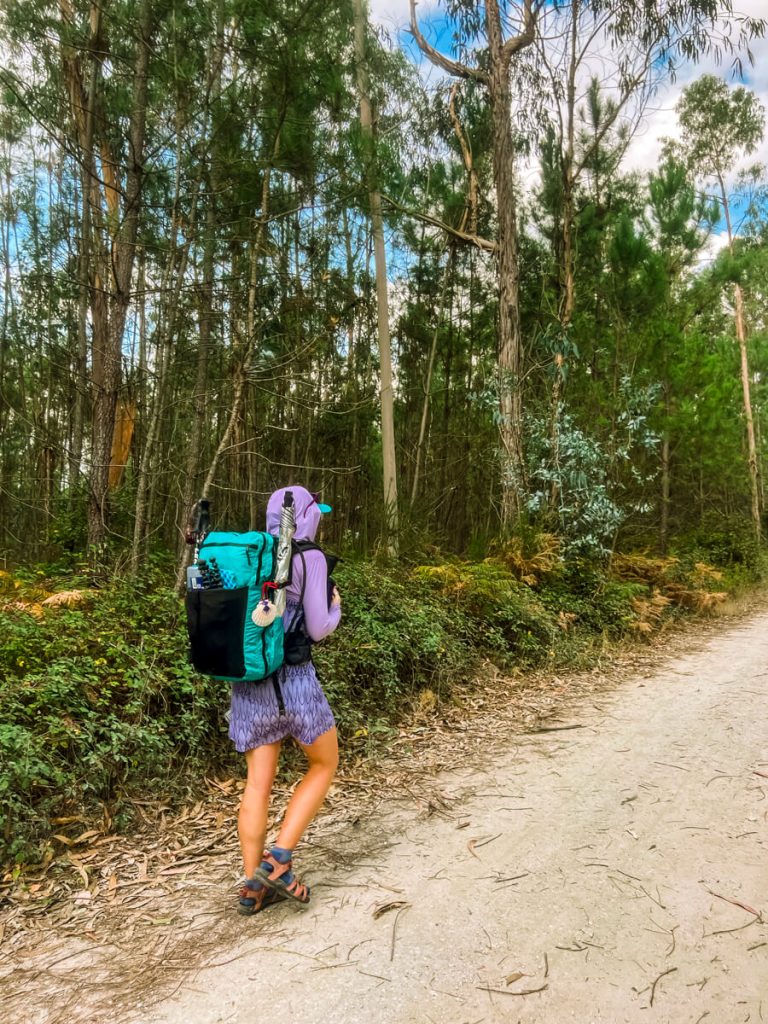
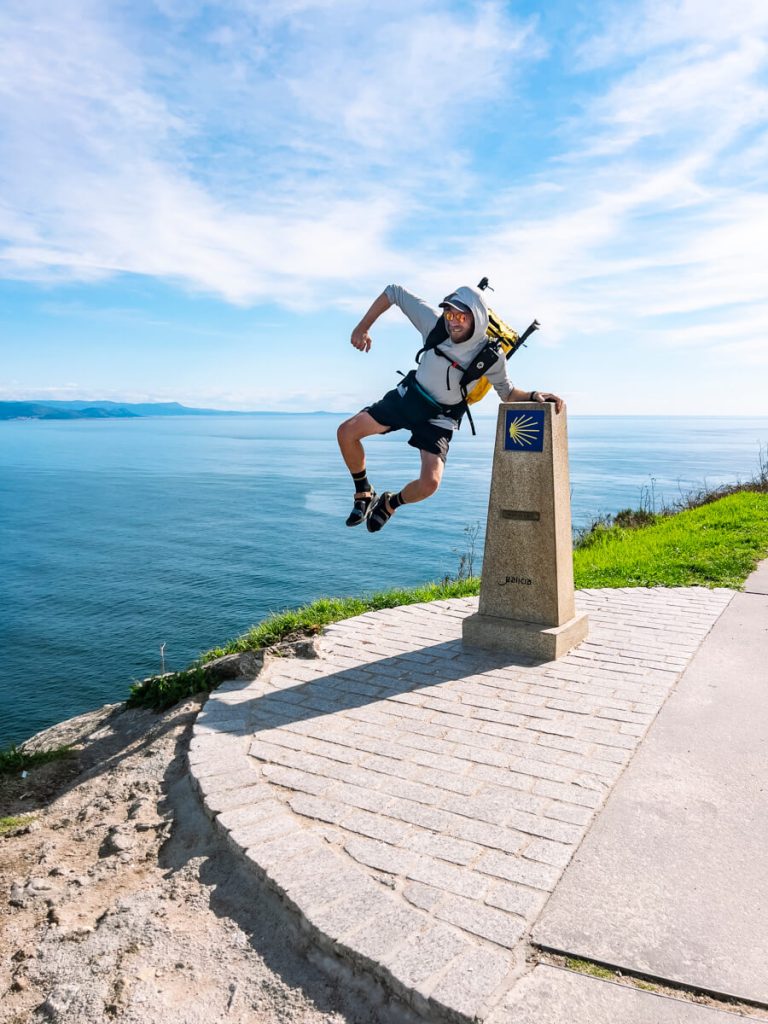
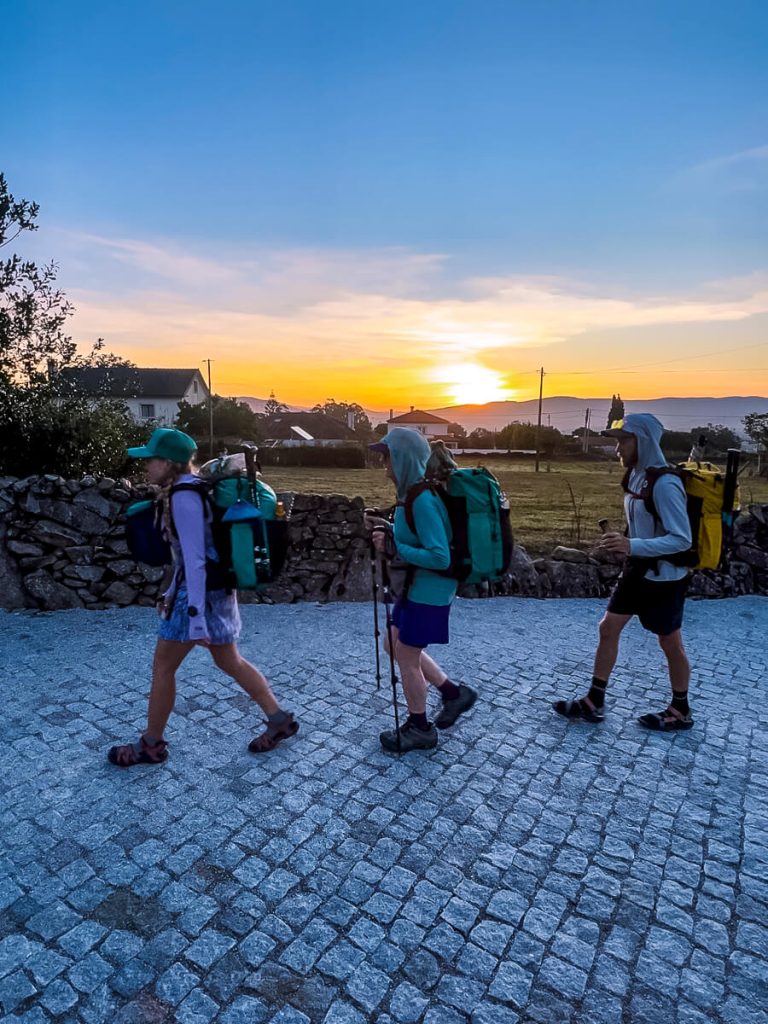
If you’d like more information on these items and why they’re included in my backpack, I’ve created a detailed Camino Packing List here.
Let’s Talk Footwear on the Portuguese Camino
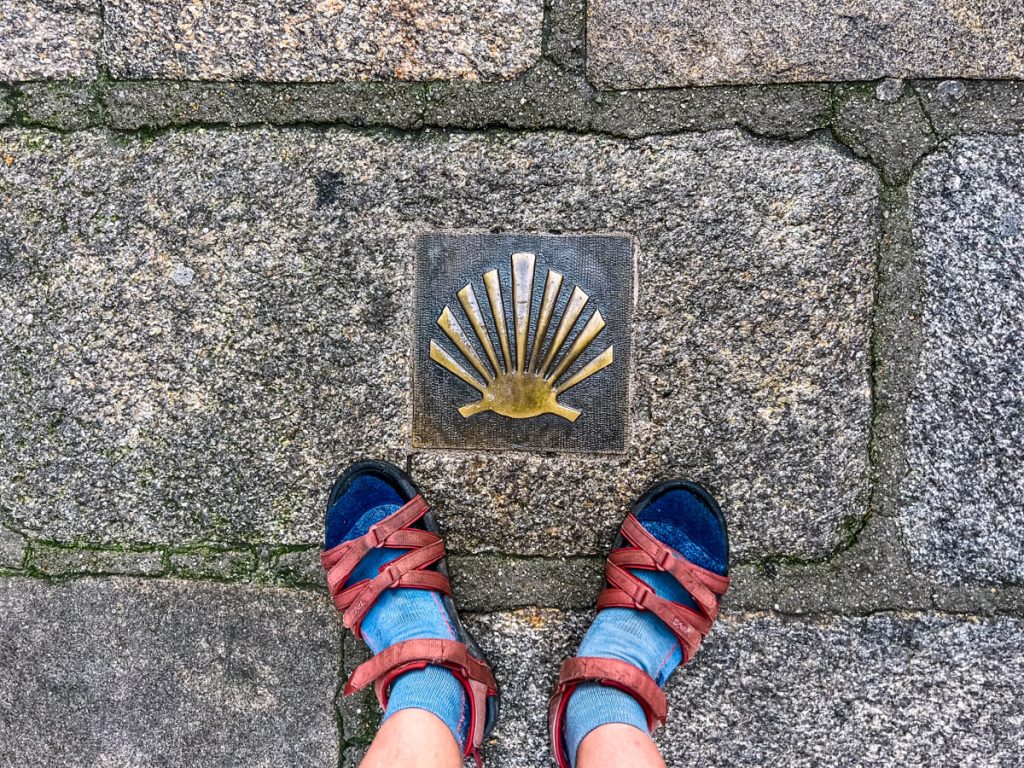
You’re only as happy as your feet when walking the Portuguese Camino.
The best shoes for the Camino will ultimately depend on your specific feet. Therefore, I’m going to give you a few tips that I’ve learned from over 20,000+ miles of hiking.
There is no one-size-fits-all best shoe for walking the Camino.
👣 The best shoe is one that fits your feet properly with space to swell, ventilation to cool, and some cushion to absorb the ground.
Even if you’re in good physical fitness, walking all day, every day on a Camino will likely make your feet swell.
Your feet could also grow. My feet grew 1-1.5 sizes after hiking long distances. This is natural and normal.
I will never recommend boots for anything without snow. They’re mostly outdated and, in my experience, often cause more problems than they solve.
So when you get footwear to walk the Camino, go through this process:
- Try them on in the store. If you go to REI, they have a mini hill to walk up and down on. It’s important to know how your feet move in the shoes going ⬆️ uphill AND ⬇️ downhill.
- Use your thumb to press down on the space from the shoe toe tip to the top of your toes inside the shoes. Can you place your thumb horizontally in that space? That’s my ideal…then as I hike downhill, my toes aren’t hitting the shoe.
- If you are a person with past ankle injuries, check out high-top trail running shoes.
- If you don’t have past ankle injuries, check out newer trail runners like Hoka, Altra, and Topos.
The Portuguese Camino is humid. You’ll want footwear that breathes. This is why I suggest trail runners. If you’re doing the section from Lisbon to Porto, I highly recommend having very breathable trail runners or even good hiking sandals (NOT the sub $30 ones).
Personally, I hike in sandals. I use the Teva Tirras and have done so for thousands of miles. Each pair lasts me 400-600 miles. You could have trail runners and use these for your shower sandals if you’d like. This would provide backup footwear in case your trail runners cause issues.
I include specific footwear options in my post about how to prevent and treat blisters.
Best Time of Year to Hike the Portuguese Camino
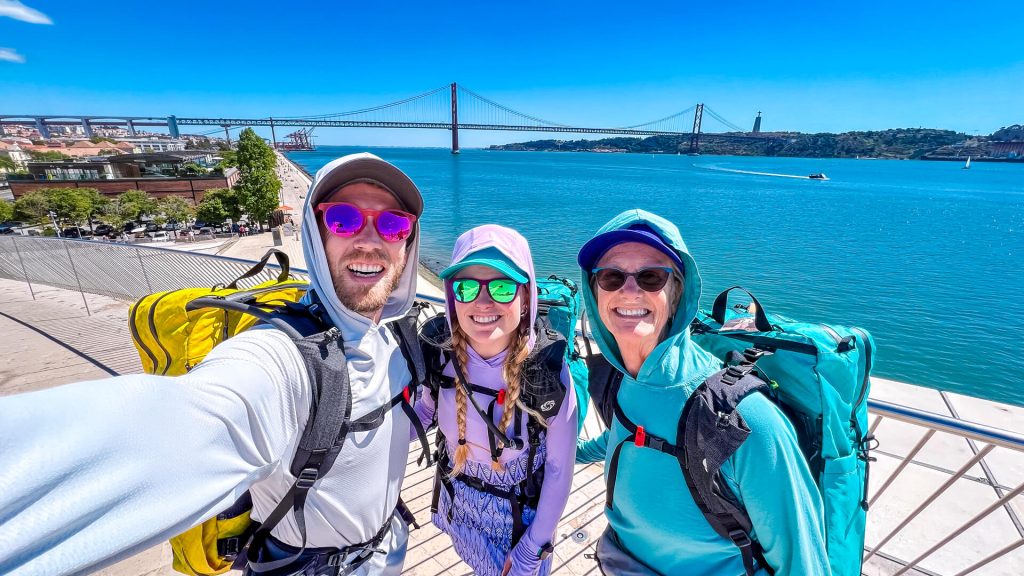
Portugal is a fantastic country with surprisingly different climates between the southern and northern regions.
A walk from Porto to Santiago could be done in the spring, summer, or fall. Summer is usually the busiest time, especially around the middle to the end of July.
However, a walk from Lisbon to Santiago should be done in the spring or fall. In my opinion, it’s too hot in the summer to safely walk this section.
We started in Lisbon in mid-September and still had a week of 90-95°F (33-35°C) with little shade. Good thing we brought our own shade with our hands-free ultralight umbrella!
While you could walk the Portuguese Camino in the winter, it’s not normally recommended because many of the albergues close. Therefore, accommodation would be a challenge and likely more expensive.
Guidebooks VS Apps for the Portuguese Camino
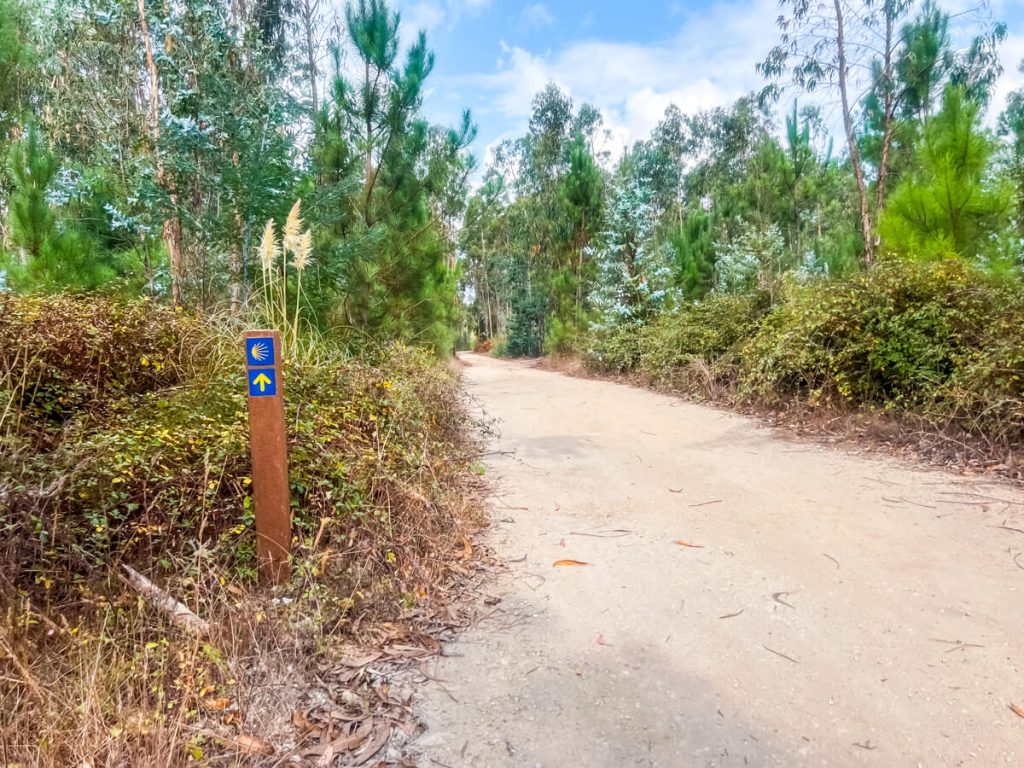
Here is the biggest move into the future that the Caminos are making.
There are now several apps as well as guidebooks.
Having hiked Caminos in the past with only guidebooks, the GPS apps are a welcome addition.
I think there is still a place for traditional guidebooks. However, I believe guidebooks best serve the purpose of learning the basic history before the walk from your couch. Otherwise, they’re heavy.
I used a combination of 3 GPS Apps for the Portuguese Camino: Wise Pilgrim, Buen Camino, and Camino Ninja.
My overall pick was Wise Pilgrim because it gave me all the important information with fewer opinions. I felt like the Buen Camino app descriptions often came from a negative viewpoint that I didn’t want in my day. The Camino Ninja app had no opinions, but they’re distances were frequently off by a kilometer or two, so I took that with a grain of salt.
Since I came from the U.S., I also needed an e-SIM to use the GPS apps without wi-fi. They all theoretically worked with offline maps. However, they glitched enough times that way that I ended up using more of my eSIM. I had a great experience using the Airalo eSIM.
Where to start: Lisbon or Porto
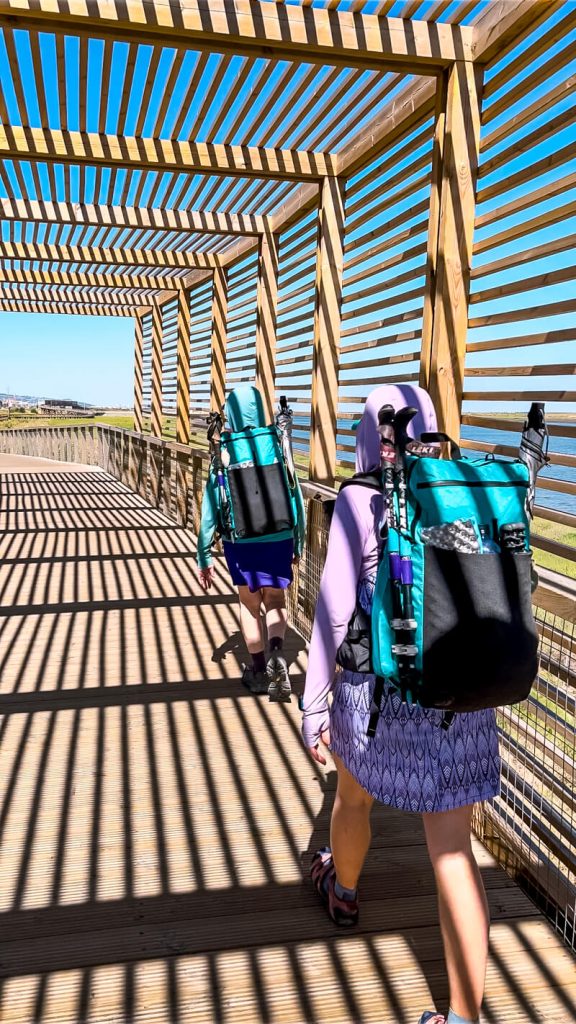
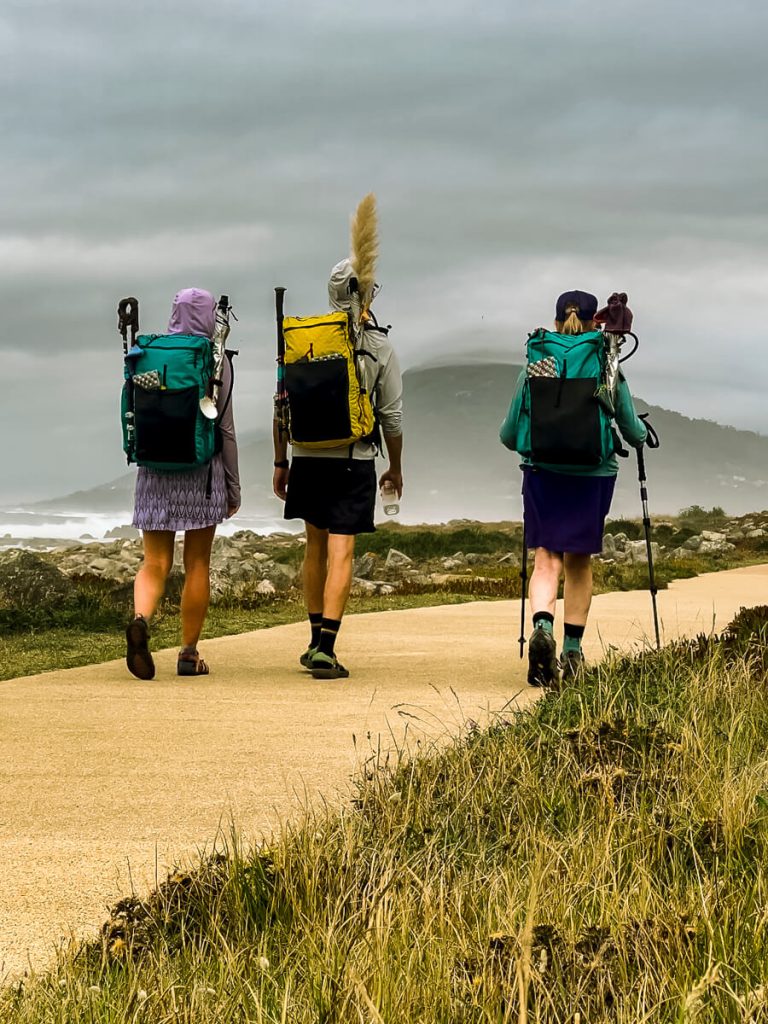
A nifty aspect of walking the Camino is that you can begin anywhere—so long as you walk 100 km (or bike 200 km) to get the pilgrim passport.
That being said, there are two main options to start the Portuguese Camino: Lisbon or Porto.
Having just walked from Lisbon to Santiago, I would suggest that most people would enjoy starting in Porto better.
That’s not to say that I didn’t enjoy the walk from Lisbon to Porto. Rather, I don’t think it’s for everyone because the stages are long and albergue options are limited.
In a nutshell, you should ask yourself some questions and see which of the categories below you feel is better for your trip.
Starting in Porto is best for people who:
- Have less time to walk
- Want to walk shorter days
- Like cooler weather
- Only have the summer to hike
Starting in Lisbon is best for people who:
- Can start hiking with long days (18-22 miles/per day)
- Want more solitude for the beginning
- Have navigated on foot with GPS before (not as many markers)
- Are ok with the above and want to hike in the spring or fall
If you’re undecided and still unsure, I’ve written a more detailed post about the stretch from Lisbon to Porto here.
Route Options after Porto
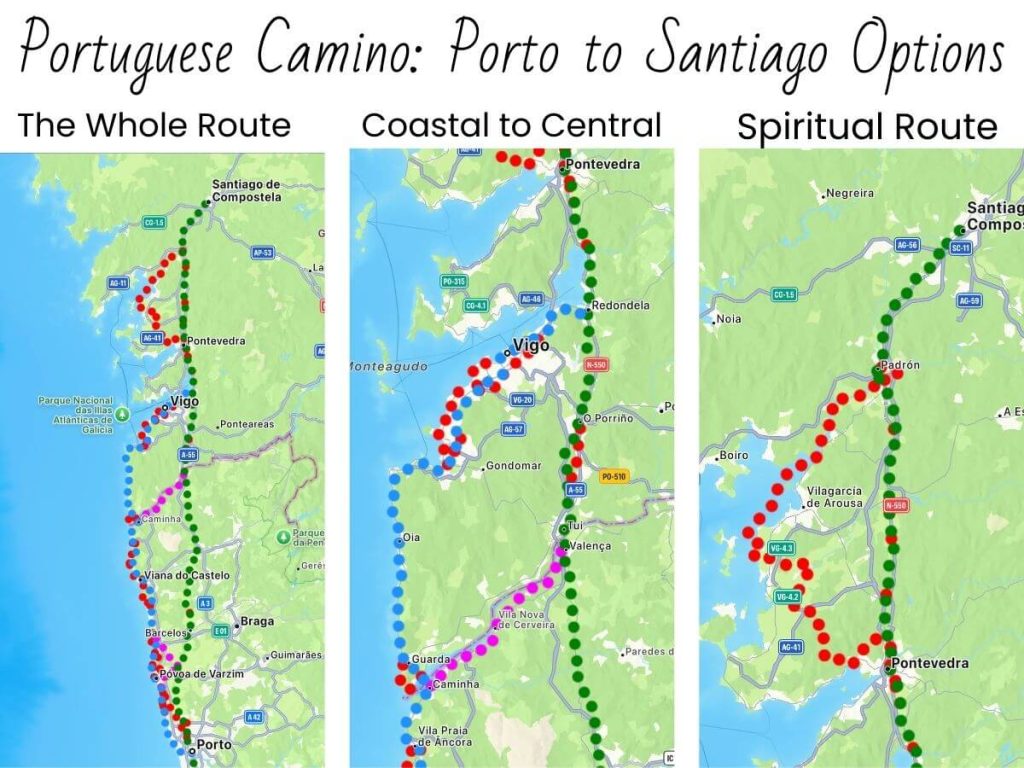
The biggest thing that separates the Portuguese Camino from the others (aside from including Portugal) is that there are route options.
Before you even get on the plane, you need to pick which route you want to start: the Coastal Route or the Central Route.
During our fall hike, we chose the Coastal Route because we wanted to be near the ocean. I loved hearing the waves and smelling the saltwater every day.
Either route you choose out of Porto will come back together well before Santiago.
🌊 The Coastal Route is best for those who:
- Are ok with a few extra miles (1-2 days more)
- Want to walk near the ocean
- Know they may get windier weather
🌲 The Central Route is best for those who:
- Want a few miles less (1-2 days less)
- Prefer having more forest time
- Want to have less windy weather
After the Coastal and Central Routes merge, there is an option to add the Spiritual Route before walking into Santiago de Compostela. We did not take this because of the weather when we got to the split.
Your Portuguese Camino walk can take many turns, and they’d all be valid. In the end, it’s up to what you feel like walking and the weather.
If you’re still undecided, I created an expanded route breakdown of Portuguese Camino kms/mileage based on all the route variations.
Staying in Albergues on the Portuguese Camino 🛌
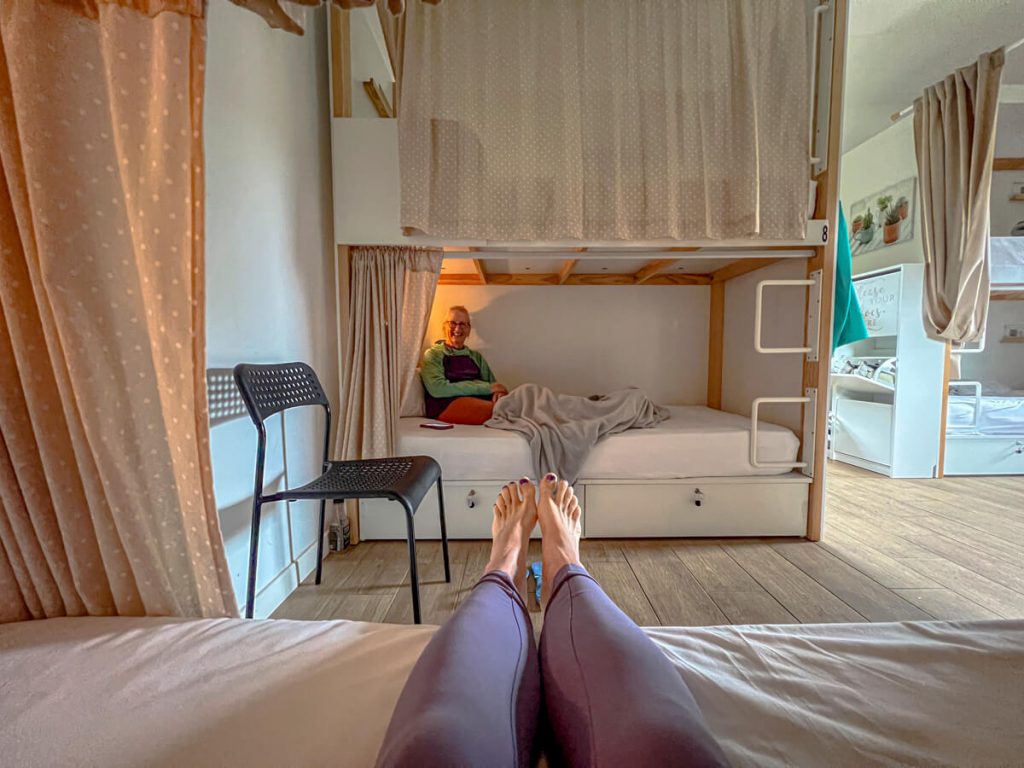
Albergues are the most unique part of walking any Camino de Santiago, and the Portuguese Way is no different.
If you’re looking for a Camino family, the albergues are where they usually form. There, you can find others cooking together, going out for meals, trying to figure out washing machines, or mutually bonding over how bad someone snored the night before.
There are two types of albergues: municipal and private. Municipal albergues are first-come, first-served. If you’re a person who likes to book ahead (I recommend only 1-2 days ahead), then you’ll aim for private albergues.
From Porto to Santiago, there are many options for albergues. You’ll usually have multiple options in larger towns and often a few in between.
🚨 However, from Lisbon to Porto, there are significantly fewer options. The recommended stages are longer in this stretch. Additionally, accommodations are scarce outside of following the stages. This makes for longer days.
Please remember to be considerate of others in shared spaces. Each albergue has basic rules to follow, but some have a few extras.
Food, Pilgrim Meals, Cafés, and Restaurants
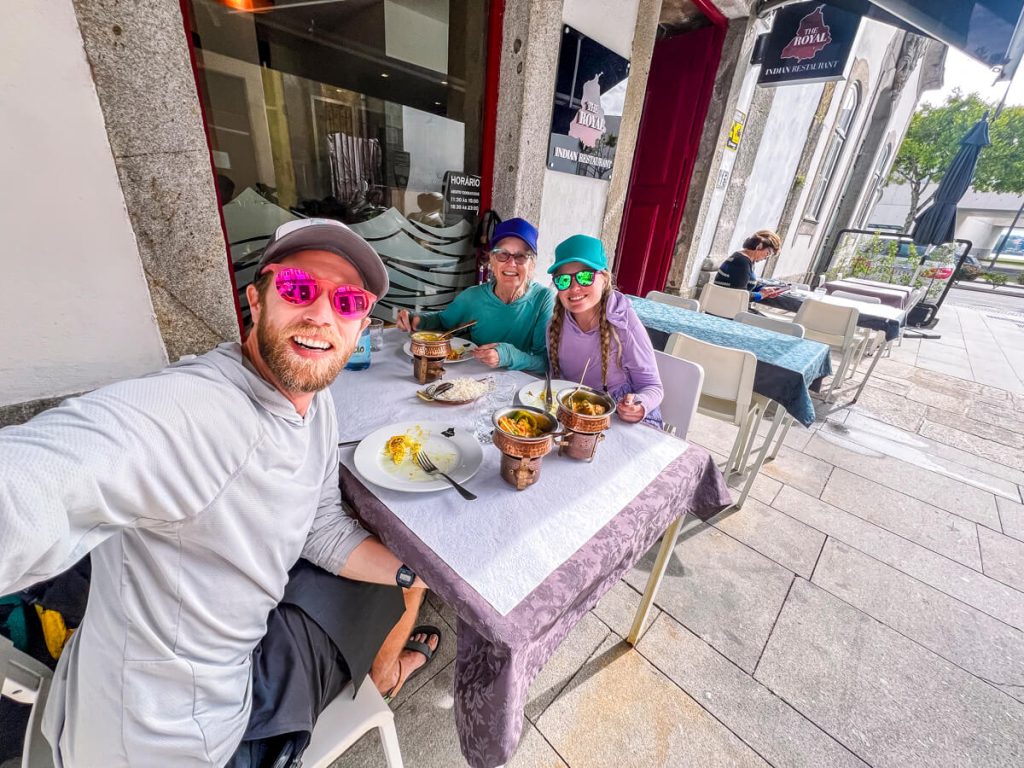
The two most frequent questions I get about hiking Caminos are “what’s the food like?” and “how much does food cost?”
The simple answer is that there is plenty of food, and the cost of food varies depending on how much you eat at restaurants.
🍽️ On the Portuguese Camino, you get two types of culinary dishes in restaurants: Portuguese foods and Spanish foods. Both culinary tastes typically have a lot of meat and fish.
However, I was very impressed with the restaurant food options on the Portuguese Camino. I had great luck finding delicious Indian food, Mediterranean food, and basic pizza (even with vegan cheese!)
💰 Most meals that we paid for at restaurants were in the 7-12 euros per person range.
☕️ There are always small cafés where you can get some basic fare like toast and sandwiches. These are less expensive and all pretty much have the same foods.
🏪 In contrast, if you go to a grocery store, you can get meal ingredients for much cheaper. However, you have to make the sandwich or cook the meal.
If you go the cooking route, double-check the albergue you’re going to has a kitchen AND what’s in that kitchen.
If you have dietary restrictions, plan ahead by considering where you can find stores that accommodate your needs. I recommend always carrying some snacks with you.
Basic Cost of the Portuguese Camino
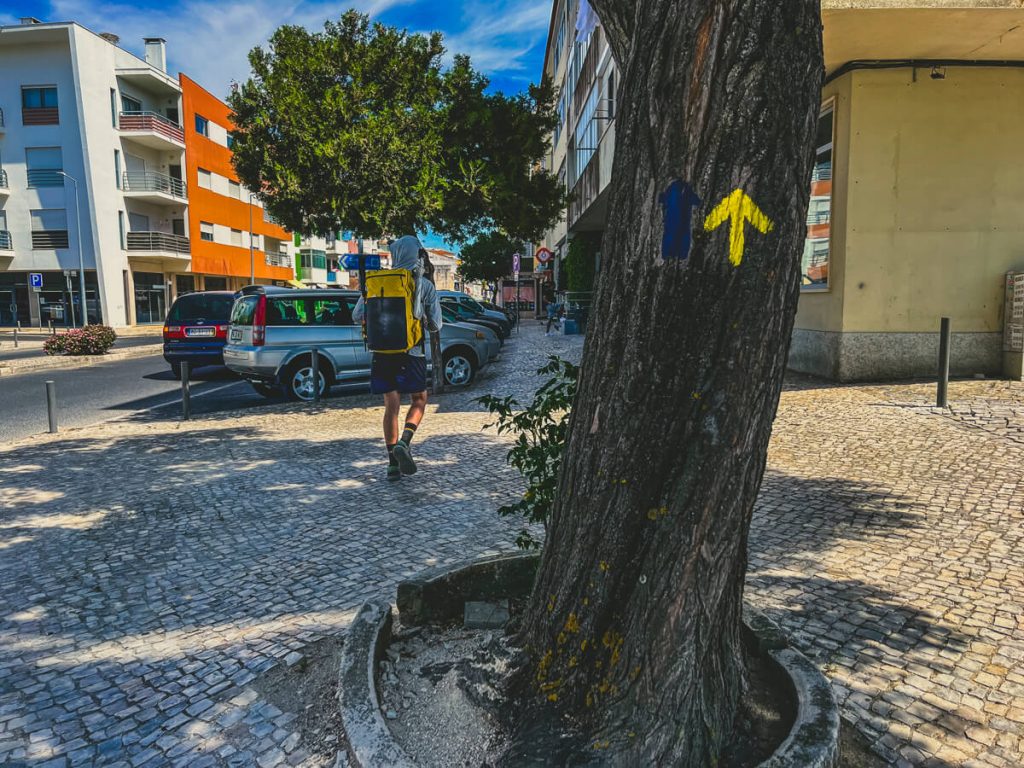
The cost of one person’s journey on the Portuguese Camino varies greatly from that of another.
Your main costs while you’re walking the Portuguese Camino are your accommodation (albergues) and food (cafés, restaurants, and grocery stores).
Additionally, you’ll need to factor in your transportation to and from the Camino. This cost will depend on where you’re traveling from.
Lastly, you’ll want to factor in some gear costs depending on what you already have.
💰 In 2024, we found the average costs were:
- 🛏️ Albergues were mostly 18-28 euros per person per night (mostly private).
- ☕️ Café lunch costs were roughly 6-8 euros per person for a basic bite to eat and coffee/tea.
- 🍽️ Restaurants were usually 10-15 Euros per entrée.
- 🛒 Grocery store cookable dinner and breakfast for 3 people was roughly 20-25 euros.
There are always ways to cut costs to have a (relatively) inexpensive Camino experience:
- 🛏️ Opt for municipal albergues whenever possible.
- 🥪 Picnic from grocery stores and cook when available at albergues.
- 🍺 Drink less adult beverages. While it’s significantly cheaper than the U.S., it adds up.
- 🎒 Buy second-hand gear at REI Garage Sales, Gear Trade, Stio Second Turn, Patagonia Worn Wear, and Facebook Marketplace.
Portuguese Camino Itineraries: Day by Day Guides
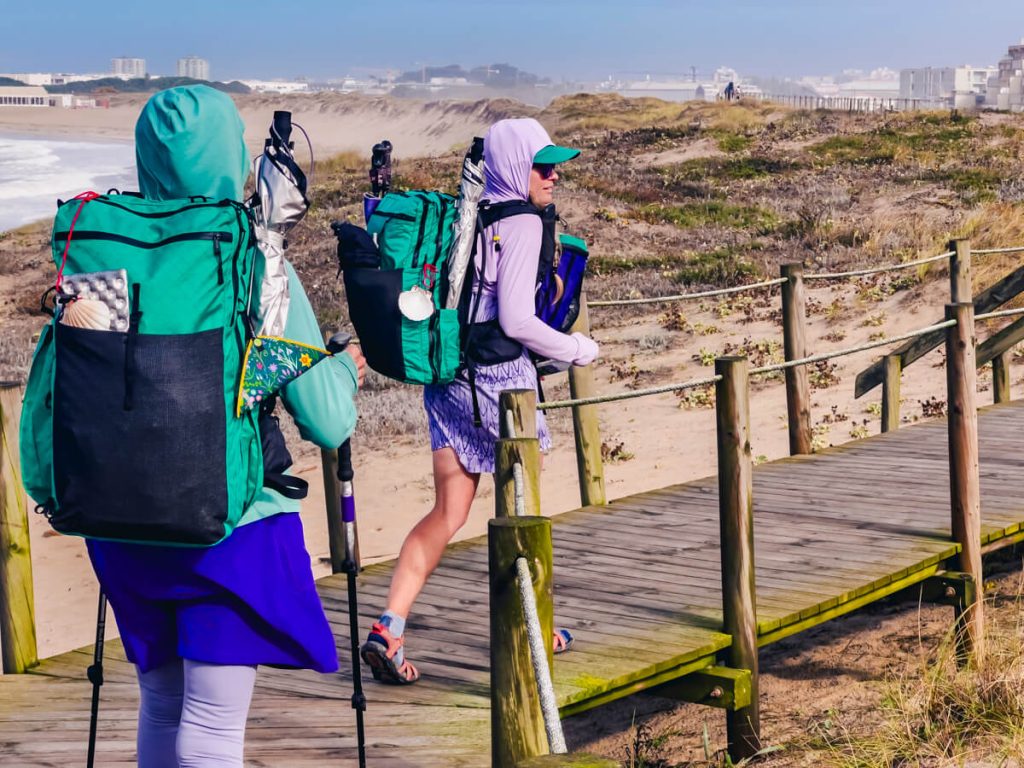
If all of the above sounds fantastic, but you’re overwhelmed with planning, I created two day by day itineraries.
Even if you don’t follow them exactly, these will at least help you plan your round-trip flights. ✈️
I added albergue recommendations based on our favorites from our fall walk. There are definitely a few hidden gems in there that we LOVED.
The first itinerary is for those who prefer a slower pace. At 9-14 miles per day (14.5-22.5 km), you have plenty of time to walk leisurely, have lunch at a restaurant, and have a nap in the albergue before dinner. P.S. This is a fantastic pace to walk the Portuguese Camino with a parent!
The second itinerary is for those who wish to hike at a faster pace. This would appeal to those who have thru-hiked already in the U.S. at 17-23 miles per day (27-37 km). Due to the nature of albergues, this is the ideal “longer” day.
I started this itinerary in Lisbon. However, those of you who want to start in Porto can just skip the beginning. You do need to hit the ground running here, so I recommend doing some training and not going right off the couch.
Getting Your Credential Certificate in Santiago
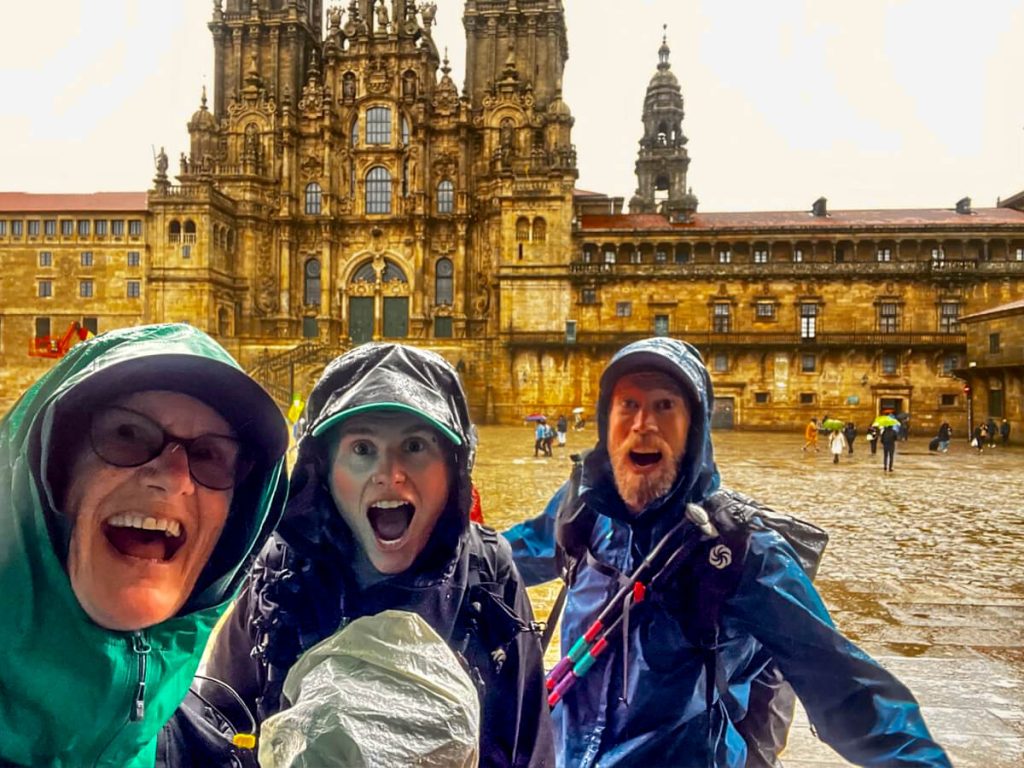
Once you get to Santiago (Yay 🥳), you’ll want to get your Compostela (certificate of completion).
🚨 However, with the new system, it’s best to start this 1-2 days before walking into Santiago (especially if you have limited time in Santiago!)
Basically, you need to fill out this form ahead of time and get a QR code. Yes, the website is legit, and yes, the selection of professions is mildly offensive.
There are three styles of certificates based on what you select in “reasons for pilgrimage.”
Once you have that digital QR code, you’re all set until you get to Santiago.
In Santiago, you’ll go to the pilgrims’ office, which is downhill near the cathedral, not inside it.
They literally won’t let you in the door without the first QR code from the online form!
Once you scan that, they give you another QR code, which tells you when you can get your certificate. If you came at the end of the day, it might be the following morning if they’re busy!
After you get your certificate and before you leave, I recommend getting the few-euro poster tube they sell. This will get your Compostela home safely.
Is It Worth It to Continue to Finisterre or Muxía?
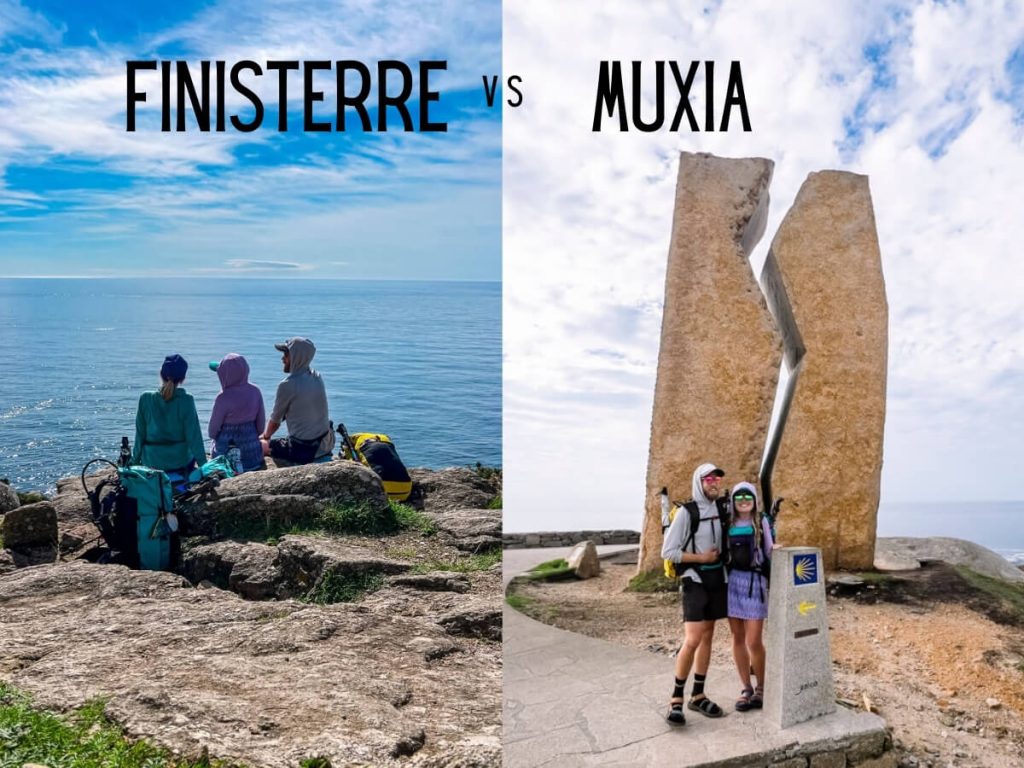
100% Yes! Continuing your walk to Finisterre and/or Muxía is WORTH IT.
I have done this on every one of my four Caminos. I highly recommend it.
Since I’m not religious, the ocean always seemed like a better place than a cathedral to end a long walk.
Plus, Santiago de Compostela is a busy city.
Finisterre (Fisterra) is a small, unique tourist town. It features restaurants, a variety of accommodations, a scenic lighthouse, and all the hippie vibes.
Muxía is a small fishing town. I prefer walking to Finisterre first, then connecting up to Muxía for quiet reflection. It also has one of my all-time favorite albergues, Bela Muxía, where I’ve stayed 3 times. The hosts are some of the kindest, most genuine people I’ve ever met.
While the finish-at-the-ocean doesn’t land the same way after hiking the Portuguese Camino coastal route, it’s a relaxing finish. Personally, having the space and time to reflect after any thru-hike is important to me, and both Finisterre and Muxía offer that.
Final Thoughts
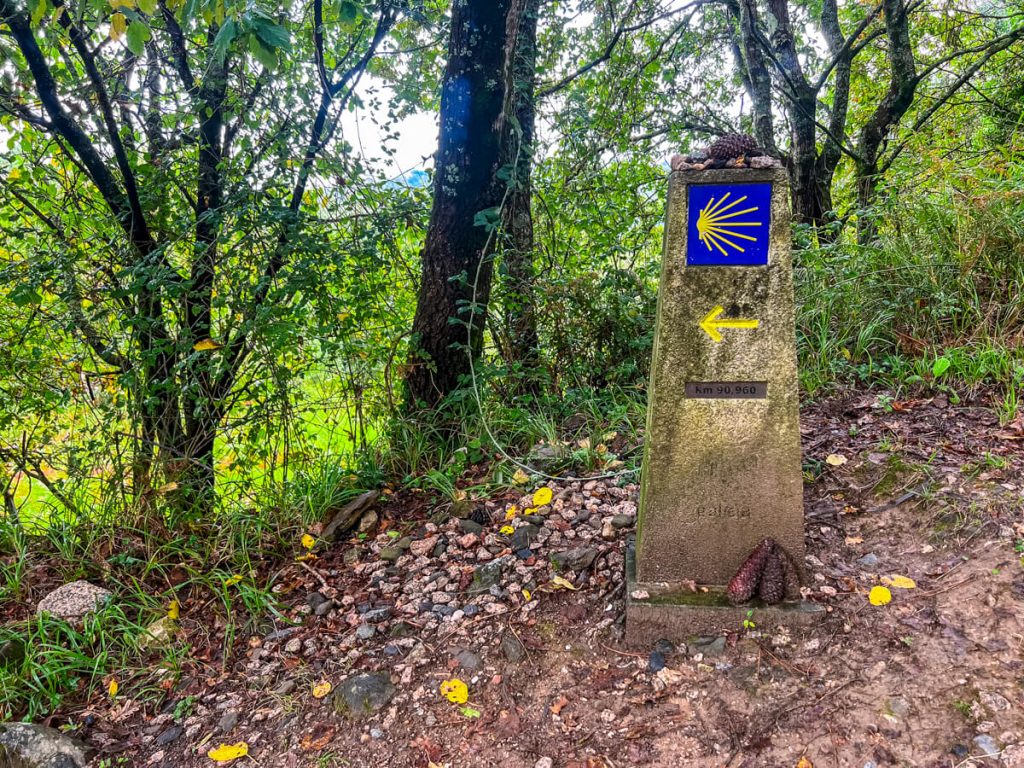
The Portuguese Camino is unique among other Caminos de Santiago. Walking through two countries is a very cool experience, no matter which route options you choose.
Don’t forget to take photos with the people you walk with—that’s what you’ll want to remember the most. The landscapes and the food are all worthy of photos as well, but I speak from experience that I look back to the people photos the most.
If you’re looking for more dirt trail and fewer people, check out the Camino Primitivo or the Camino del Norte.
I hope you have a great adventure and you get what you need out of your walk!
Happy Trails!
📌 Pin it for Later!