DWTH Day 59: Bailing to Return Later
Stats
👣 Miles: 11.63
📈 Elevation Gain: 164 ft
📉 Elevation Loss: 2,290 ft
Overall Weather: Cold, Overcast, Rain
This post contains affiliate links. I have used every product mentioned, and if you purchase one of these products, I can make a small commission at no cost to you.
Morning Decision Making Round 2
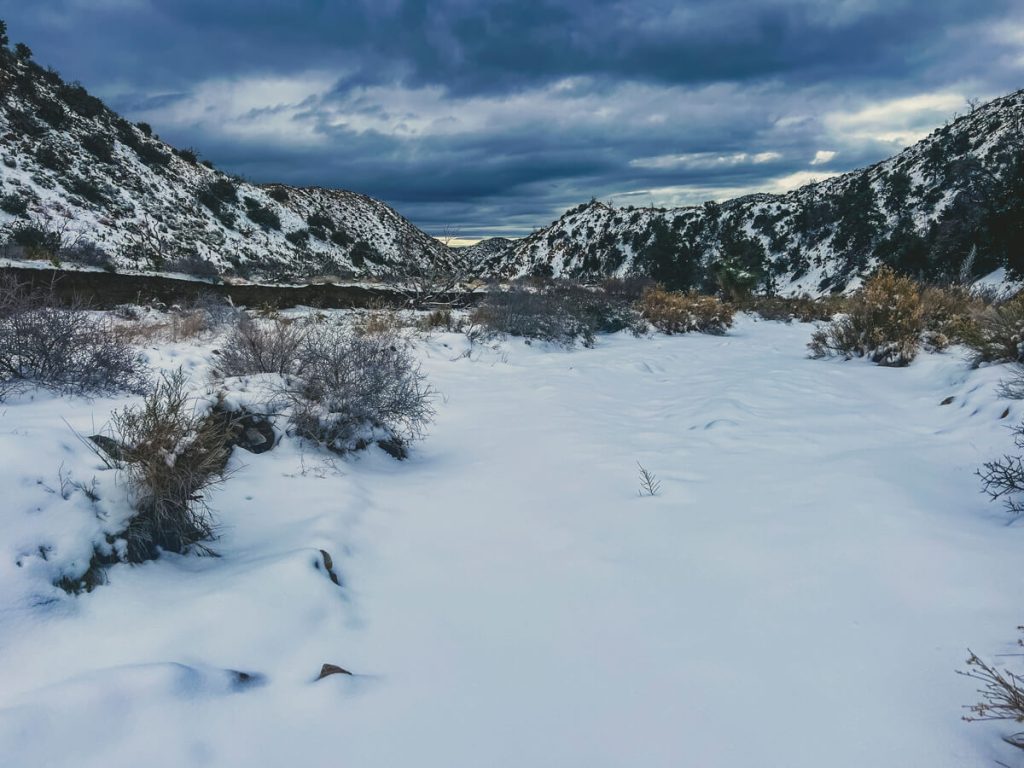
Again, we faced the same dilemma:
- 1.) Go up 9.5 miles, 2,500ish more feet of elevation gain in snow, and hope for a hitch either way on a road with a winter storm warning.
- 2.) Go down 7.5 miles to potable water, a road, possibly some road walking to a hitch point, and decreasing snow.
We had a few other factors in play:
- 1.) We ran out of fuel, melting snow into water. Our water would easily last in either direction (hitch-dependent going up). So, if we went up and no one picked us up, we’d have a 9-mile, possibly icy road walk to Big Bear.
- 2.) Running out of fuel cut out one cooked meal option, decreasing the amount of food we had.
- 3.) We did not have our seal skin socks (waterproof socks not actually made out of seal skin). Those help significantly with cold snow sandal walking.
- 4.) We checked the weather forecast each day from our InReach, and it changed for the worse each time for 6-8,000 ft. The storm itself was an odd one coming southwest from Vegas instead of from the coast. I got the impression the forecasters really had no idea what it was doing either. Looking outside, it looked like another day of shit was coming.
- 5.) The logistics were harder hitching from Highway 38 than doubling back. After picking up the caches, we got to a high enough elevation that we could complete the final 9 miles in an 18-mile out-and-back day hike with the van.
- 6.) Gear was starting to break. We snapped another guideline in the snow and had to fix it. The last bad water we had screwed our Sawyer Squeeze Filters. The orange gunk that tasted like rotten eggs made our fillers taste smoky. Our sandals were rapidly dying from hard desert terrain, which was made worse by picking out spikey cacti and now snow.
Based on all of the above, it was quickly becoming apparent that we should choose the safer option of heading down and coming back later.
We’ve both heard enough outdoor stories and podcasts and things going wrong to see that multiple factors were lining up to make the potential for a bad situation higher.
Most times, when an outdoor rescue needs to happen, it’s a lot of small decisions compounding to make a bad situation. When you have these small things combined with volatile weather, things can go awry fast.
While we pay for the Garmin Delorme InReach safety and rescue package, I don’t want to use it if I can prevent it by making safer decisions. It is better to use it to check the weather and text our responsible, thru-hiker friend Crosby, who could give us details we didn’t have, like the highway conditions above. It’s better to use it for more information to make smarter decisions.
Packing Up
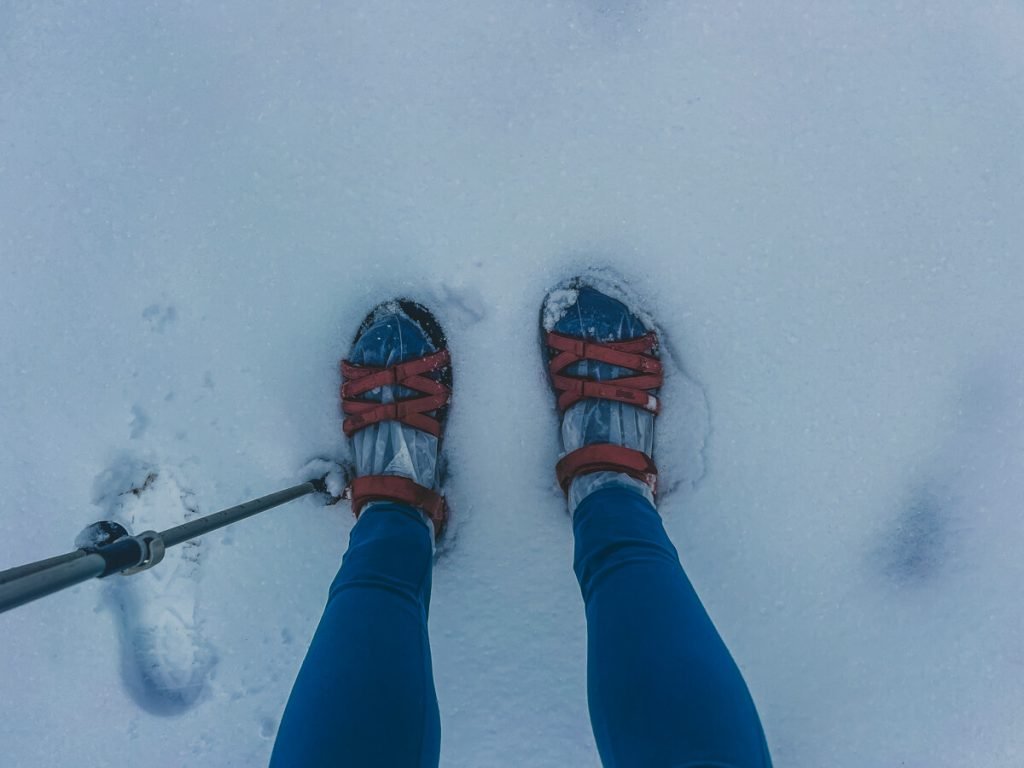
Packing up in snow always takes longer. It’s cold; you need your hands out to do things, and the things you’re touching are cold.
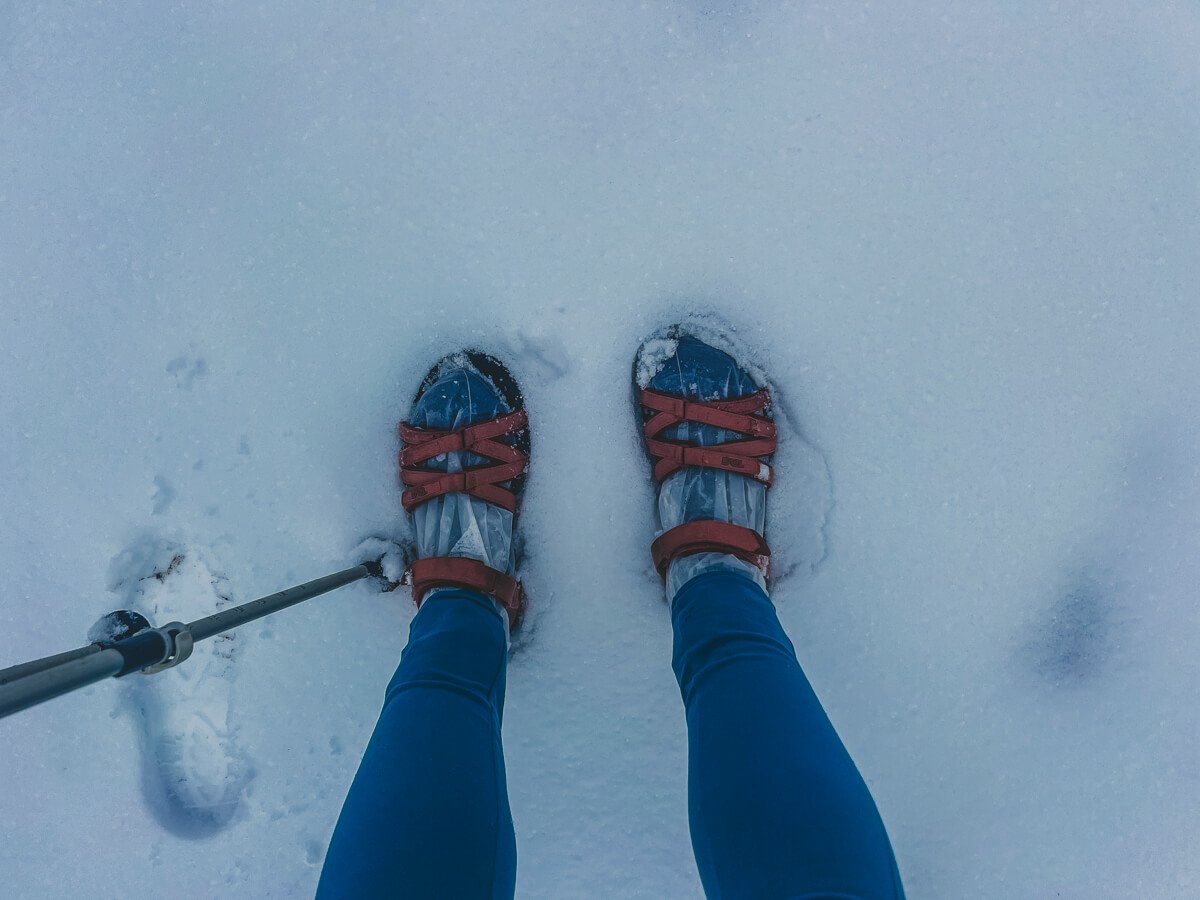
We packed up and added gallon Ziplock bags to our feet (our Arizona Trail trick from 2019). While they make your feet sweat a bit, they prevent them from freezing—as long as you clear the snow from the arches of your feet and under your toes frequently.
Going down, we figured we’d only have 2-4 miles of snow.
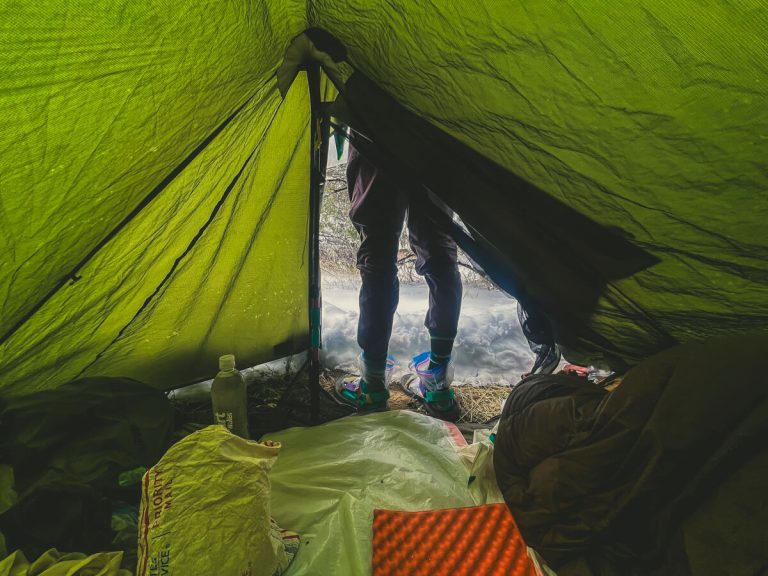
Packing up the tent is always the worst. The bug net came out easily and was mostly dry. The tarp had a frost layer that got rained on as we awoke, and some of the rocks secured to the stakes had frozen to the snow. Karma stuffed the freezing tarp while I got so the stakes.
From there, we moved. In the cold, you have to keep moving. You can’t stop longer than about 5 minutes without losing your moving warmth.
A Snowy Wash
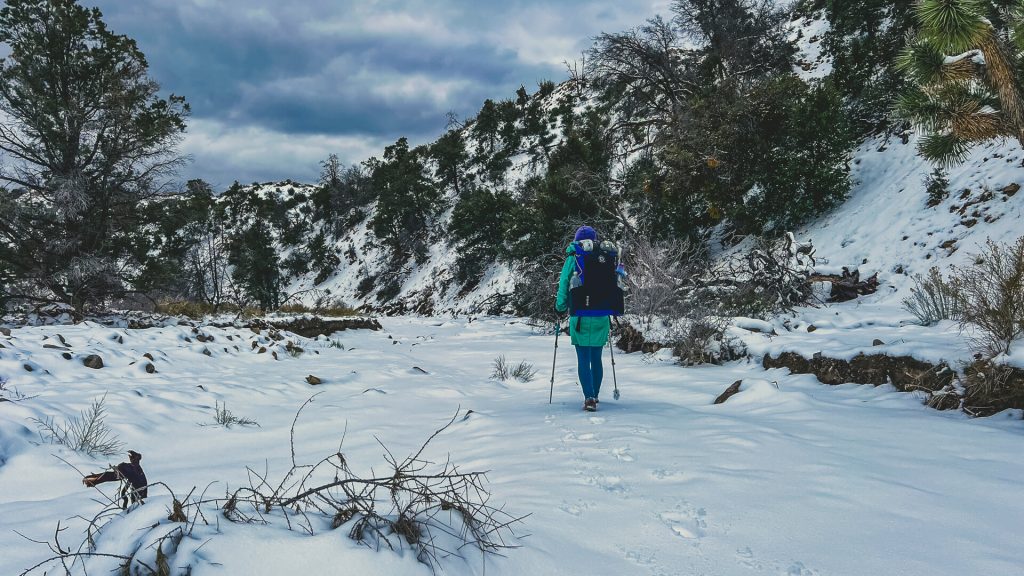
We aimed to walk the wash downhill. Rocks there had melted the snow a bit more. The “road” on the shelf was barely there anyway. Walking downhill in the wash would have less impact; no navigation would be needed.
We came across fresh deer tracks crossing the wash twice and some coyote tracks once.
Our feet stayed warm enough in the ziplock bags.
The sky threatened more weather and we hoped to get beyond the willow crawling and bushwhacking before more weather started. The forecast we had predicted precipitation around 2 pm, while Crosby’s forecast predicted rain starting in the late morning.
Surprise, Wildlife!
Out of nowhere, we finally saw a Great Horned Owl sitting in a grove of trees nestled in a willow thicket.
We’ve heard them so much over the past two months, but this is the first one we saw well. We saw another one a bit back in the Mojave preserve, but only as it was flying away from us.
This one flew around us to different perches. Neither of us managed a good photo due to the super thick vegetation and its fast speed, but it was so cool to see it.
Then, about a quarter mile later, we saw two Cooper’s Hawks making quite the sounds.
Potable Water and Lunch
It started to rain right at the end of the willow bushwhacking.
We got back to Ranger Station and filled up some water from the bathroom sink. Then, we ate a bagel lunch and sat for a few minutes on the benches under the awning.
Knowing the parking lot there, we assumed we’d have to walk to Pioneertown to get a ride to Yucca Valley. When it’s raining, you’ve gotta take rest where you can, especially if you need to eat anything other than a bar.
Road Walk Back to Pioneertown
We walked the road back to the crazy, weird Western tourist attraction. Having the umbrellas up made the cars give us a bit more space. I maybe held the umbrella out a bit on a few cars who didn’t want to give us safe space.
Neither of us had enough cell service to try for an Uber, so hitching it was.
We stood in a good spot with space to pull over, where multiple parking lots dumped people onto the road. The speed was slow for the tourist attraction.
We decided to give it 10 minutes. If we stood there too long, we would get too cold.
All the tourists seemed to think we were part of the attraction, and lots of them waved at us but didn’t pull over. None of the Tesla trucks or cars so much as looked at us; the Hummers, Range Rovers, and Mercedes looked away. The fancy vans ignored us, too. We joked that they weren’t true adventures despite all the adventure gear strapped onto them.
Right at the 10-minute mark, we got an old van. We knew of that old van didn’t pick us up, no one would.
He passed us but then quickly turned around and made space for us. Sometimes, you just know when a car will pull over. Rex was a super awesome guy doing some really neat home-building, and his dog’s name was Polly! When we told him our van’s name was Polysprout, and we called it Poly for short, he loved it.
Yucca Valley Round 2
Rex dropped us off at America’s Best Value Inn and Suites. He said they were weird but probably the most afordable option. There was no way we were going to the Best Western again.
We got a room and did hiker chores: shower, laundry, and food. For the first time, we ordered from Uber Eats, and it worked out fantastically! We got delicious Thai food after a cold day.
We made plans for a ride back to the van with Karma’s Mom and started to consider how to return in about two weeks with the van for those last nine or so miles.